I seem to be spending the golden years of my life trying to save toppled columns.
But, like Gladstone’s attempts to rescue fallen women, my work has largely been in vain.
For several years, I struggled to rescue a remarkable Column of Infamy from a dusty sepulchre in the Doges Palace in Venice. To this quest, I applied my best efforts and those of Venice’s most vigorous social historian Nelli Elena Vanzan Marchini. We tried to have the column brought out of darkness for the 700th anniversary of the 1310 conspiracy of Baiamonte Tiepolo, who planned to murder the Doge and seize the state. After his failure, Baiamonte’s own palace was razed to the ground. The Column of Infamy erected in its place. The column thereafter suffered a series of adventures, being damaged by a paid vandal, sold, moved, spending some time as a garden ornament by a lake, sitting unloved in a courtyard of the Correr Museum, and finally being ignominiously consigned to the darkness by the Fondazione Musei Civici di Venezia.
Yet Baiamonte’s Column of Infamy is one of the oldest pieces of inscribed stone in Venice. It is not fragile. And it’s only four feet high. I obtained the support of Venice in Peril to restore it. I sourced sponsorship for the work. Nelli-Elena organised a book and two conferences. I shared a platform at the Ateneo Veneto with the director of Musei Civici, delivering a lecture on the evocative power of the column and the nature of villainy. But I suspect this only strengthened the director’s resolve that no chit of a foreign novelist would ever bring forth a precious item of Venetian history.
And so, Reader, I failed. The column still languishes in the Doges Palace dungeons, and I doubt if the ducal tweeny maid has even given it a dusting in the last hundred years.
And now, in London, I find myself on the trail of a tier gate that has gone missing from the charming little warehouse complex known as Blows Yard, now overshadowed by a modern development in Stoney Street, by the historic Borough Market in Southwark.
The tier gate or pillar in question is brother to this one, pictured at right.
The two pillars were sturdily built of tough blue engineering bricks, with bull nosed bricks on the corners for most of their height. Each was then topped by a ziggurat of white stone. They defined the northern western edge of the site.
Blows Yard is part of the Borough High Street Conservation Area. The statutory definition of a Conservation Area is an “area of special architectural or historic interest, the character or appearance of which it is desirable to preserve or enhance.”
Note ‘desirable to preserve or enhance’.
Blows Yard stands on land that was once part of the Bishop of Winchester’s domain. Early maps show its site within the kitchen gardens of Winchester Palace. Below is a drawing showing the palace and its gardens in 1660 after Wenceslas Hollar (image courtesy of Wikimedia Commons).
Eight hundred years ago, the palace was the most important building on the south bank of the Thames. But after the Civil War the site expropriated by the state. Stoney Street was built through the old palace grounds. A row of little houses was added on the eastern side of the new street – these can be seen on Horwood’s plan of 1799. Otherwise the new buildings were devoted to river-based trades. Warehouses grew where the Bishop’s vegetables once flourished. Winchester Palace was razed by two fires in the early 1800s, (as was my own home).
English Heritage now manages what is left of Winchester Palace, which is classed as Scheduled Ancient Monument. The area is also an Archaeological Priority Zone.
In June 2006 Southwark Council’s appraisal of the Borough High Street Conservation Area explained how the area changed from palatial demesne to small industrial development: In time, much of the area was redeveloped with purpose-built warehouses and, although limited in area, the small quarter of riverside warehousing around Clink Street retains characteristics of 19th century London dockland streets that are so typical of areas east of Borough. The urban form is characterised by very narrow streets hemmed in by tall building elevations and is a response to the practical and economic need to maximise building areas for the business of storing goods coming in off the ships. The streets themselves are reduced to minimal widths and warehouses were linked to one another with catwalks and bridges overhead.
It further observes of Blows Yard: the buildings have a pleasant consistency of detail using parapet gables and arched warehouse windows in a two and three storey composition, and they contain Stoney Street tightly, facing the railway arches … Blows Yard is particularly important as a corner group onto Stoney Street, and is neatly and consistently detailed.
Note the “neatly and consistently detailed”.
London County Council published an excellent series of books in the 1950s in conjunction with the London Survey Committee. The Survey of London Volume XXII deals with Bankside, the parishes of St Saviour and Christchurch, Southwark, and was my bible when writing The Remedy, my novel in which a Venetian aristocrat on the run from a murderous state agent hides out in seedy Bankside, as a quack doctor’s assistant. It also helped me through The Mourning Emporium, a story in which Venetian children sail to London in order to deal with a murderous pretender to the British throne. The London section of the book is set around Clink Street, Stoney Street and nearby haunts. Various maps in Volume XXII show Blows Yard surrounded by long-gone streets with picturesque names like Naked Boy Yard, the Whore’s Nest, and Bandy Leg Walk.
Blows Yard has also been in danger over the last decades. But, after various attempts to demolish it, the building was subject to a sensitive and respectful interior reworking and is now our beloved local Pain Quotidien.
The redevelopment of Blows Yard was undertaken in conjunction with the Museum of London Archaeological Survey (MoLAS), and left all the archaeology beneath untouched and safe. The remains of Roman buildings were revealed in addition to medieval structural elements of the scheduled Winchester Palace.
So, a case of good planning, good architecture and good practice.
But even this good practice has not stopped the northernmost of the Blows Yard pillars from disappearing.
Both pillars were still there in May 2011, when SE1 magazine photographed the street to report on a confrontation between local residents and developers who wanted to place a 300 cover restaurant adjacent to Blows Yard. Photograph courtesy of the SE1 website, with thanks.
A compromise of sorts was reached. Thereafter the site was swaddled in layers of boarding and scaffolding for several years. And now that the boarding and scaffolding are gradually coming down – one of the pier pillars has disappeared. I poked a trespassing head around the gates last week, and found … absolutely no northern pillar, as this picture by David Stephens shows.
I even looked under the yellow hoarding and all I found was this: just some rubble and roots.
My distress at the missing pier pillar was channelled, as all good History Girls channel their woes, into research.
My first call was The London Archaeologist Annual London Fieldwork and Publication Round-up of 2009, which recorded that the two extant buildings that now comprise Blows Yard were constructed by as a horse hospital, the works probably taking place between 1872 and 1877.
Now I was more than curious – I was also charmed. A Horse Hospital in Stoney Street! It made perfect sense. Horse transport was still predominant in Victorian London, with at least 300,000 working horses in the city. There were around 90 veterinary surgeries, no doubt principally devoted to their care. Many, like Blows Yard, would have incorporated smithies or farriers. London Bridge was the transit hub of centuries past, as testified by old coaching inns like The George. I could imagine exhausted horses arriving from Dover or Folkestone, being led between the two pillars into the hospital for a bit of R & R and two nice new pairs of shoes.
Perhaps it was rather like this jolly illustration from George Cruikshank’s My Sketchbook, courtesy of Wellcome Images.
At the Museum of London’s Archaeology department, I spoke to Karen Thomas, who was kind enough to send me the full text of their 2009 study of Blows Yard.
The archaeologists had found the Horse Hospital listed in the Goad insurance plans of 1877. (My theory would be that the word ‘Blows’ referred to the striking of the anvil by the smithy – or it could be an elision of ‘Bellows’, an essential tool of the blacksmith’s works.)
In 1882 Kelly’s Post Office Directory (a kind of Victorian Yellow Pages) recorded the premises as horse hospital run by Mr William Roots, veterinary surgeon. His other address was elegant Trinity Square, so this must have been his professional headquarters. I found him again in The Commercial Gazette of 1890. His complex consisted of a stables with hayloft on the upper floor. There were also two small dwellings, possibly inhabited by stable boys or junior surgeons who tended to the sick horses at night. The archaeologists found traces of tiling, drainage ventilation suitable for the housing of horses, which would also have had space to lie down.
They found few traces, however, of the ‘Smithy and stable’ due to various demolitions. There is now just a blank gable fronting on to Stoney Street and part of the roof, plus two gate piers or posts. The archaeologists noted, ‘These piers are of solid brick, with pyramidal moulded capstones, possibly of white limestone or artificial stone, partly built into the adjoining buildings’.
So in 2009, when the archaeologists finished this work, both piers were still in place.
The archaeologists theorized that Blows Yard operated as a horse hospital until just before or during the First World War, when the current owners, J.O. Sims, took it over for the fruit and vegetable business, probably using the existing stables for the dray horses who transported their goods.
At some point in the twentieth century, Sims stopped using the building for their business. They rented it to a recording studio for a period. And eventually it became Pain Quotidien.
PQ occupies the stable and the hayloft, with its kitchen in the cottages, I believe. The smithy would have been located in a part of the site that is now being pushed for yet more development
The missing pillar would have marked its northernmost point.
It would be nice to think that the pillar was temporarily removed for its own safety, and that perhaps the pieces of the pillar are stored carefully in a warehouse somewhere, awaiting reconstruction. Indeed, I suggested as much to the developer, but received no answer at all.
No answer at all is an answer, I feel.
Nevertheless, I nurture a slender hope that the pillar still exists.
Why do I care? This pillar was no more than 150 years old, a callow youth of a pillar compared to Baiamonte's 700 year old column. It has no historic inscription. It was made of engineering bricks and stone. It was not even particularly beautiful. It had a stolid, comforting presence, redolent of a confident industrial past.
And it was a part of the historic fabric of Stoney Street, part of the Borough High Street Conservation Area, in the grounds of Winchester Palace and adjacent to a scheduled Ancient Monument, part of an Archaeological Priority Zone.
And it represents just one more way in which the history of this area is being treated with disrespect. In another recent development a tourist gift shop has inflicted lurid neon lighting on the street.
The residents here are active in their support of the area. We warmly welcome responsible local businesses. We try to stop developments that seem cynical or damaging to our architectural heritage. David Stephens, our local architect, together with English Heritage and residents, conceived a beautiful historic garden in the ruins of the old Winchester Palace, formerly the home of tumbleweeds and cigarette butts. Bankside Open Spaces Trust and Southwark Council agreed to realize the scheme. And now it is in place.
Yet there seems to remain a practically feudal state of affairs here in the Clink, where the rich landowners can, with apparent impunity, exercise droit de seigneur over the vulnerable historic fabric of the area.
This blog represents, therefore, a small ladylike blast of the trumpet against the anonymous wall of non-caring. Should we not celebrate our industrial past here? Mr Roots’s Horse Hospital is but one piece of our history. Also gone – the walkways that used to join the warehouses to the other streets – those went in the late seventies; local lurks like Naked Boy Yard and the Whores Nest – all demolished to make way for profitable high-rise developments.
Pillar by pillar is the way that the fabric of our environment was built.
And pillar by pillar it will be lost – unless someone with authority can be found to care about it enough.
Michelle Lovric’s website
Her most recent novel is The True & Splendid History of the Harristown Sisters, published by Bloomsbury.
She rarely writes about horses as she is rather afraid of them since being attacked by a wild Australian one in her childhood.
Showing posts with label horses. Show all posts
The Year of the (Green) Horse
...also Blue, Red and White! by Caroline Lawrence
My fellow History Girl Katherine Roberts recently blogged about horsey books for YA readers and got me thinking!
When schoolchildren ask me what I would do if I could time-travel back to ancient Rome, I always answer without hesitation: A day at the races! When I was researching the 12th book in my Roman Mysteries series, The Charioteer of Delphi, I learned so many amazing things about chariot racing I had never come across whilst studying Classics at Uni. Here are twelve fascinating facts that convinced me this would have been THE most exciting thing to do in the Eternal City.
1. Chariot racing was the most popular public event in Imperial Rome, attracting far greater crowds than beast fights and gladiatorial combats.
2. The size of the arenas reflect this: the Flavian Amphitheatre (now known as the Colosseum) held 50,000 people keen to watch beast fights and gladiatorial combats. But the Circus Maximus held five times that number! Nearly a quarter of a million people could fit in Rome’s famous hippodrome. As far as I know, there is no arena of equivalent size in the world today.
3. Unlike the Colosseum, women and men could sit together at the races. This is why the poet Ovid tells young men that the Circus Maximus is a good place to pick up girls!
4. Chariots were not the sturdy wooden vehicles we see in almost every dramatisation of Ben Hur. They were very springy and light so they could go as fast as possible. Oil lamps, frescoes and reliefs show that they were made of wicker and leather. Driving one would have been like driving a basket on wheels!
5. Most chariots were pulled by ungelded stallions; two for a biga (2-horse chariot) and four for a quadriga (4-horse chariot). As many as twelve teams ran in each race. That means you could have the testosterone of up to 48 ungelded stallions thundering around the racecourse at any one time.
6. Charioteers were mainly young men in their teens and twenties. Some of them achieved superstar status, but like football players today, you stayed faithful to your faction (your team) not to specific personalities. The life expectancy of a chariot racer was not long, and if one survived more than a thousand races he became known as a miliarius or thousander. It was the same for a horse!
7. The charioteer would tie the reins around his waist. This left his right hand free to wield the whip and his left to tweak one of the eight reins. With the reins tied around his waist, he could use his whole body to steer. He wore a curved knife in his belt so that if he was thrown from his chariot he could cut himself free as he was being dragged along.
8. Whenever a chariot crashed, the crowd would yell out naufragium! This means ‘shipwreck’ in Latin! See? I told you it was fun!
9. Some charioteers downed a concoction of bull’s mucus before the race to make them more phlegmatic (i.e. to calm them down). They called this disgusting potion snorteum.
10. Four dozen horses thundering around a dirt track could raise a cloud of dust thick enough to obscure the action and choke the spectators. For this reason there were special boys called sparsores (or sprinklers) to keep the dust down. They would run out onto the track between laps and sprinkle the dust with water. There were frequent fatalities.
11. For me, the most exciting fact is that every single element of the Circus is symbolic, relating it to the cosmos.
• The four faction colours represented the four seasons and also the four humours or temperaments. Red stood for summer or the choleric temperament. Blue was autumn and also melancholic. White was winter and phlegmatic. Green was spring and sanguine. Charioteers wore leather helmets and jerkins in the four colours of their factions. The horses were adorned with ribbons and gear in these colours, too.
• The seven laps represented the days of the week.
• The twelve starting gates (and lanes) represented the months of the year.
• There were often twenty-four races held per day. These represented the hours of the day.
• The water of the euripus (canal in the central spina) represented the sea.
• The dirt race-track represented the earth around the sea.
• The obelisk rising from the euripus represented the sun.
12. Finally, as if to prove how little some things change, you could buy chariot-themed souvenirs at the Circus Maximus such as glass beakers or clay oil-lamps.
Now come on, admit it! Wouldn't a day at the Roman races be your first choice, too?
Caroline Lawrence writes history-mystery books for kids. She has written over twenty books set in first century Rome and is now writing a series about a detective in the Wild West. There are horses in those books, as well. For more info, go to www.carolinelawrence.com and follow her @CarolineLawrenc
My fellow History Girl Katherine Roberts recently blogged about horsey books for YA readers and got me thinking!
When schoolchildren ask me what I would do if I could time-travel back to ancient Rome, I always answer without hesitation: A day at the races! When I was researching the 12th book in my Roman Mysteries series, The Charioteer of Delphi, I learned so many amazing things about chariot racing I had never come across whilst studying Classics at Uni. Here are twelve fascinating facts that convinced me this would have been THE most exciting thing to do in the Eternal City.
1. Chariot racing was the most popular public event in Imperial Rome, attracting far greater crowds than beast fights and gladiatorial combats.
3. Unlike the Colosseum, women and men could sit together at the races. This is why the poet Ovid tells young men that the Circus Maximus is a good place to pick up girls!
4. Chariots were not the sturdy wooden vehicles we see in almost every dramatisation of Ben Hur. They were very springy and light so they could go as fast as possible. Oil lamps, frescoes and reliefs show that they were made of wicker and leather. Driving one would have been like driving a basket on wheels!
5. Most chariots were pulled by ungelded stallions; two for a biga (2-horse chariot) and four for a quadriga (4-horse chariot). As many as twelve teams ran in each race. That means you could have the testosterone of up to 48 ungelded stallions thundering around the racecourse at any one time.
6. Charioteers were mainly young men in their teens and twenties. Some of them achieved superstar status, but like football players today, you stayed faithful to your faction (your team) not to specific personalities. The life expectancy of a chariot racer was not long, and if one survived more than a thousand races he became known as a miliarius or thousander. It was the same for a horse!
7. The charioteer would tie the reins around his waist. This left his right hand free to wield the whip and his left to tweak one of the eight reins. With the reins tied around his waist, he could use his whole body to steer. He wore a curved knife in his belt so that if he was thrown from his chariot he could cut himself free as he was being dragged along.
8. Whenever a chariot crashed, the crowd would yell out naufragium! This means ‘shipwreck’ in Latin! See? I told you it was fun!
9. Some charioteers downed a concoction of bull’s mucus before the race to make them more phlegmatic (i.e. to calm them down). They called this disgusting potion snorteum.
10. Four dozen horses thundering around a dirt track could raise a cloud of dust thick enough to obscure the action and choke the spectators. For this reason there were special boys called sparsores (or sprinklers) to keep the dust down. They would run out onto the track between laps and sprinkle the dust with water. There were frequent fatalities.
11. For me, the most exciting fact is that every single element of the Circus is symbolic, relating it to the cosmos.
• The four faction colours represented the four seasons and also the four humours or temperaments. Red stood for summer or the choleric temperament. Blue was autumn and also melancholic. White was winter and phlegmatic. Green was spring and sanguine. Charioteers wore leather helmets and jerkins in the four colours of their factions. The horses were adorned with ribbons and gear in these colours, too.
• The seven laps represented the days of the week.
• The twelve starting gates (and lanes) represented the months of the year.
• There were often twenty-four races held per day. These represented the hours of the day.
• The water of the euripus (canal in the central spina) represented the sea.
• The dirt race-track represented the earth around the sea.
• The obelisk rising from the euripus represented the sun.
12. Finally, as if to prove how little some things change, you could buy chariot-themed souvenirs at the Circus Maximus such as glass beakers or clay oil-lamps.
Now come on, admit it! Wouldn't a day at the Roman races be your first choice, too?
Caroline Lawrence writes history-mystery books for kids. She has written over twenty books set in first century Rome and is now writing a series about a detective in the Wild West. There are horses in those books, as well. For more info, go to www.carolinelawrence.com and follow her @CarolineLawrenc
Year of the Wood Horse - Katherine Roberts
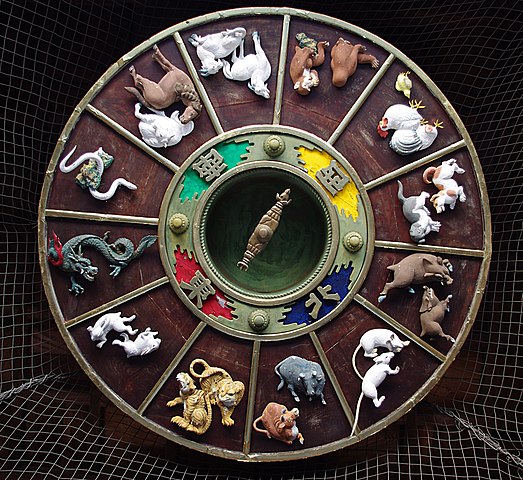
No, not the one stuffed full of Greeks that destroyed the ancient city of Troy, although war is meant to be one of the wood horse's characteristics! This is the Chinese Year of the Wood (or Green) Horse, which began earlier this week and heralds a year of similar nature to that of 60 years ago, when the element of wood last coincided with the animal sign of the horse. (1954, if my calculations are correct... anyone remember that one?)
| Chinese zodiac wheel (picture thanks to wikipedia) |
The Chinese zodiac dates back to the Han dynasty of 206-220BC and works on a 12-year cycle, rather than the 12-month cycle associated with our western zodiac. Each year is named after an animal:
Rat
Ox
Tiger
Rabbit (Hare)
Dragon
Snake
Horse
Goat
Monkey
Rooster (Hen)
Dog
Dog
Pig
In addition, the Chinese believe that the universe is made up of five elements – earth, water, fire, wood, metal – which interact with the 12 animals to influence the year ahead.
![]() |
| a tiger galloping along the water? |
As a horse lover, I've got a natural fondness for horse years, although it seems I was not born in one - I am a tiger (a water tiger to be accurate), but that's ok since tigers can apparently get on well with horses... which is maybe just as well, since I enjoy riding them! You are a probably a horse if you were born in 1918, 1930, 1942, 1954, 1966, 1978, 1990, or 2002 although if your birthday falls in January or early February you might be a snake instead. Famous historical figures born in the Year of the Horse include (rather appropriately) the Mongol leader Genghis Khan, the artist Rembrandt, French scientist Louis Pasteur, and US president Franklin Roosevelt.
If you want to check which Chinese zodiac sign you were born under and discover your horoscope for 2014, try this site.
According to the Chinese, this is a year to be bold. There is a lot of fire involved, and may be battles, since the wood aspect means people will stick to their guns this year and not be prepared to negotiate. I imagine it as a rather stubborn horse, digging in his toes when forced to carry a rider where he does not want to go, but galloping keenly in his chosen direction. I have decided it will be a good year to get my Genghis Khan novel out of its drawer and into the world, since my fascination with the Chinese zodiac began while I was doing the research for that book a few years ago... and, of course, it has horses in it!
In the meantime, some other YA books you might like to explore in this Year of the Wood Horse are:
I Rode a Horse of Milk White Jade by Diane Wilson - an award-winning young adult title set in the time of Kubla Khan, a delightful story for readers young and old.
The Fire Horse Girl by Kay Honeyman - which I haven't read yet, but the title caught my eye.
I am the Great Horse - the story of Alexander the Great told (with a little help from me) by his warhorse Bucephalas, who left some of his hoof prints across territories later crossed by Genghis Khan.
Troy by Adele Geras - not Chinese, but it contains the famous wooden horse of Greek myth.
Please feel free to add your own recommendations in the comments, and maybe we'll build a History Girls list of titles for this Year of the Horse!
*
Katherine Roberts writes historical fantasy/legend for young readers. Her latest series is the Pendragon Legacy quartet about King Arthur's daughter, available from Templar Books in hardcover, paperback or ebook, which comes complete with magical mist horses from the enchanted land of Avalon. Look out for the free e-prequel - "Horse of Mist" - coming soon!
More details at www.katherineroberts.co.uk
Cant
by Marie-Louise Jensen
In early Georgian times it became fashionable, especially for well-to-do young men to speak 'cant' or slang; the language as spoken by the poor or more especially by the less-respectable members of society. Namely, the sharpers, the sharks, the bites, the wild-rogues, the varlets, the queer-bluffers, the rascals and scoundrels.
There is a lot of fun to be had. I've not yet been able to master the vocabulary fully enough to create a canting character, and in any case I think it might be bewildering for my young readership, but I do like to throw in a few Georgian expressions now and again. Some of these are cant and some are simply expressions that have fallen out of usage.
We had some discussions about some of these at the copy-edit stage recently. Because most are outdated and unheard-of now. Where would be the fun if they were still current? But who today knows about job horses, match-bays or wantyres? Horses are no longer our form of transport.
Nor do we any longer have such widespread suffering from gout, so the expression 'in the gout' to depict an ageing gentleman rendered grumpy, difficult and at times incapacitated by a painful condition is no longer familiar.
I also wanted a character to use the expression 'sick as a cushion' for comic effect. Then when called upon to defend it, I couldn't find it anywhere. One of my editors did track it down in the OED (hurrah!) but in the end we settled for 'sick as a parrot' which is probably more comic.
I haven't yet managed to work in 'farting crackers' to a manuscript (a cant term for breeches) although I fully intend to one day. But I did have to track down an era-appropriate term for a man's privates. I found tool, which I thought was comic without being crude. And did you know that a cant term for testicles was 'whirlegigs'? I don't even want to think about how that might have originated...
Here is the cover of the new book (publishing next June) that provided the fun:

In early Georgian times it became fashionable, especially for well-to-do young men to speak 'cant' or slang; the language as spoken by the poor or more especially by the less-respectable members of society. Namely, the sharpers, the sharks, the bites, the wild-rogues, the varlets, the queer-bluffers, the rascals and scoundrels.
There is a lot of fun to be had. I've not yet been able to master the vocabulary fully enough to create a canting character, and in any case I think it might be bewildering for my young readership, but I do like to throw in a few Georgian expressions now and again. Some of these are cant and some are simply expressions that have fallen out of usage.
We had some discussions about some of these at the copy-edit stage recently. Because most are outdated and unheard-of now. Where would be the fun if they were still current? But who today knows about job horses, match-bays or wantyres? Horses are no longer our form of transport.
Nor do we any longer have such widespread suffering from gout, so the expression 'in the gout' to depict an ageing gentleman rendered grumpy, difficult and at times incapacitated by a painful condition is no longer familiar.
I also wanted a character to use the expression 'sick as a cushion' for comic effect. Then when called upon to defend it, I couldn't find it anywhere. One of my editors did track it down in the OED (hurrah!) but in the end we settled for 'sick as a parrot' which is probably more comic.
I haven't yet managed to work in 'farting crackers' to a manuscript (a cant term for breeches) although I fully intend to one day. But I did have to track down an era-appropriate term for a man's privates. I found tool, which I thought was comic without being crude. And did you know that a cant term for testicles was 'whirlegigs'? I don't even want to think about how that might have originated...
Here is the cover of the new book (publishing next June) that provided the fun:
Subscribe to:
Posts (Atom)