Showing posts with label Katherine Roberts. Show all posts

Time and Boudica's Daughters - Katherine Roberts

Tomorrow, Templar will publish our very first History Girls anthology Daughters of Time, edited by Mary Hoffman, with short stories from authors of this blog who write for young readers:


My story is first in the book by virtue of being about the 'daughter' who comes first on the historical timeline - Boudica, warrior queen of the Iceni - so I'm sneaking in here a day before publication to write one of the first posts on the book's blog tour.

Boudica's story is a brutal one, containing material at first sight unsuitable for younger readers - both her daughters were reported to have been raped by the Romans, but rape is obviously not something I could include in a children's book, so my first challenge was to work out how to tell the story without losing its power.
 
This is not the first time I've written a short story about the queen of the Iceni. My first attempt "Empire of the Hare" was published in a small women's literary fiction magazine QWF in 1998, when it was also shortlisted for the Library of Avalon Geoffrey Ashe Prize.


In this version, which was published for an adult readership, I used the elder daughter to tell the story and had her fall in love with the Roman tax collector, meaning that she had already lost her virginity behind the stables with her Roman sweetheart before the rape scene. This was long before the days of ebooks, when Boudica was spelt Boudicca (and sometimes still Boadicea - the spelling in common use when I first came across the red-haired warrior queen at school, and therefore always the most romantic one in my mind). I also named her daughters differently, since this was pre-internet days and no popular names existed to confuse people... or if they did, I was not aware of them. Historically, of course, the girls' names are not recorded, and neither is the queen's childhood name - she received her popular name Boudica, which means 'Victory', when she led her people against the Romans.

statue of Queen Boudica in London

The young readership Templar proposed for Daughters of Time gave me the perfect opportunity to use Boudica's younger daughter to give the story a new slant. In "Tasca's Secret", my heroine Tasca is removed from the violence before it begins by her young Roman friend Marcus, who sneaks her into his father's camp when the soldiers attack Boudica's village. The younger daughter is therefore held as a hostage but not mistreated. Later, when the queen captures Marcus to take her revenge, Tasca defies her mother to save her friend.

If you know a young reader who has been inspired by Queen Boudica's story, I came across a wonderful illustrated poem about her over at History for Kids, which is written with the same age group in mind and uses humour to brighten up the history.

To me, this is one of the joys of writing historical fiction. There is always a new way into an old story - whether it is a different viewpoint, or a fictional character (such as the boy Marcus in "Tasca's Secret") who can be introduced to breathe new life into historical fact, or a different style that can be used to tell it. There is even a bit of leeway with well-known historical characters, especially if their ages are flexible, as with Boudica's daughters.

I know the other History Girls who contributed to this anthology have taken their own unique route into their chosen stories, which they'll be telling you more about at various stops on the blog tour. I, for one, am looking forward to reading all the stories when the anthology is published tomorrow!

~~~

Daughters of Time (edited by Mary Hoffman) includes stories by Penny Dolan, Adele Geras, Mary Hoffman, Diane Hoffmeyr, Marie-Louise Jensen, Catherine Johnson, Katherine Langrish, Joan Lennon, Sue Purkiss, Celia Rees, Katherine Roberts, Anne Rooney, and Leslie Wilson.

Katherine Roberts writes historical fantasy and legend for young readers. Her latest series Pendragon Legacy about King Arthur's daughter is also available from Templar. More details at www.katherineroberts.co.uk


The Year of the (Green) Horse

...also Blue, Red and White! by Caroline Lawrence

My fellow History Girl Katherine Roberts recently blogged about horsey books for YA readers and got me thinking!

When schoolchildren ask me what I would do if I could time-travel back to ancient Rome, I always answer without hesitation: A day at the races! When I was researching the 12th book in my Roman Mysteries series, The Charioteer of Delphi, I learned so many amazing things about chariot racing I had never come across whilst studying Classics at Uni. Here are twelve fascinating facts that convinced me this would have been THE most exciting thing to do in the Eternal City.

1. Chariot racing was the most popular public event in Imperial Rome, attracting far greater crowds than beast fights and gladiatorial combats.

2. The size of the arenas reflect this: the Flavian Amphitheatre (now known as the Colosseum) held 50,000 people keen to watch beast fights and gladiatorial combats. But the Circus Maximus held five times that number! Nearly a quarter of a million people could fit in Rome’s famous hippodrome. As far as I know, there is no arena of equivalent size in the world today.

3. Unlike the Colosseum, women and men could sit together at the races. This is why the poet Ovid tells young men that the Circus Maximus is a good place to pick up girls!

4. Chariots were not the sturdy wooden vehicles we see in almost every dramatisation of Ben Hur. They were very springy and light so they could go as fast as possible. Oil lamps, frescoes and reliefs show that they were made of wicker and leather. Driving one would have been like driving a basket on wheels!

5. Most chariots were pulled by ungelded stallions; two for a biga (2-horse chariot) and four for a quadriga (4-horse chariot). As many as twelve teams ran in each race. That means you could have the testosterone of up to 48 ungelded stallions thundering around the racecourse at any one time.

6. Charioteers were mainly young men in their teens and twenties. Some of them achieved superstar status, but like football players today, you stayed faithful to your faction (your team) not to specific personalities. The life expectancy of a chariot racer was not long, and if one survived more than a thousand races he became known as a miliarius or thousander. It was the same for a horse!

7. The charioteer would tie the reins around his waist. This left his right hand free to wield the whip and his left to tweak one of the eight reins. With the reins tied around his waist, he could use his whole body to steer. He wore a curved knife in his belt so that if he was thrown from his chariot he could cut himself free as he was being dragged along.

8. Whenever a chariot crashed, the crowd would yell out naufragium! This means ‘shipwreck’ in Latin! See? I told you it was fun!

9. Some charioteers downed a concoction of bull’s mucus before the race to make them more phlegmatic (i.e. to calm them down). They called this disgusting potion snorteum. 

10. Four dozen horses thundering around a dirt track could raise a cloud of dust thick enough to obscure the action and choke the spectators. For this reason there were special boys called sparsores (or sprinklers) to keep the dust down. They would run out onto the track between laps and sprinkle the dust with water. There were frequent fatalities.

11. For me, the most exciting fact is that every single element of the Circus is symbolic, relating it to the cosmos.

• The four faction colours represented the four seasons and also the four humours or temperaments. Red stood for summer or the choleric temperament. Blue was autumn and also melancholic. White was winter and phlegmatic. Green was spring and sanguine. Charioteers wore leather helmets and jerkins in the four colours of their factions. The horses were adorned with ribbons and gear in these colours, too.

• The seven laps represented the days of the week.

• The twelve starting gates (and lanes) represented the months of the year.


• There were often twenty-four races held per day. These represented the hours of the day.

• The water of the euripus (canal in the central spina) represented the sea.

• The dirt race-track represented the earth around the sea.

• The obelisk rising from the euripus represented the sun.

12. Finally, as if to prove how little some things change, you could buy chariot-themed souvenirs at the Circus Maximus such as glass beakers or clay oil-lamps.

Now come on, admit it! Wouldn't a day at the Roman races be your first choice, too?

Caroline Lawrence writes history-mystery books for kids. She has written over twenty books set in first century Rome and is now writing a series about a detective in the Wild West. There are horses in those books, as well. For more info, go to www.carolinelawrence.com and follow her @CarolineLawrenc

Year of the Wood Horse - Katherine Roberts


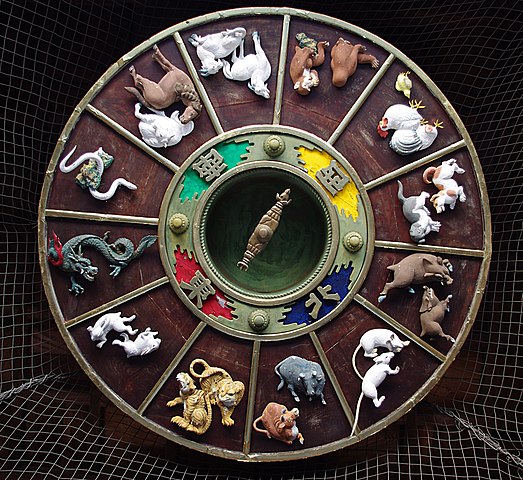
No, not the one stuffed full of Greeks that destroyed the ancient city of Troy, although war is meant to be one of the wood horse's characteristics! This is the Chinese Year of the Wood (or Green) Horse, which began earlier this week and heralds a year of similar nature to that of 60 years ago, when the element of wood last coincided with the animal sign of the horse. (1954, if my calculations are correct... anyone remember that one?)

Chinese zodiac wheel (picture thanks to wikipedia)

The Chinese zodiac dates back to the Han dynasty of 206-220BC and works on a 12-year cycle, rather than the 12-month cycle associated with our western zodiac. Each year is named after an animal:

Rat
Ox
Tiger
Rabbit (Hare)
Dragon
Snake
Horse
Goat
Monkey
Rooster (Hen)
Dog
Pig

In addition, the Chinese believe that the universe is made up of five elements – earth, water, fire, wood, metal – which interact with the 12 animals to influence the year ahead.

a tiger galloping along the water?

As a horse lover, I've got a natural fondness for horse years, although it seems I was not born in one - I am a tiger (a water tiger to be accurate), but that's ok since tigers can apparently get on well with horses... which is maybe just as well, since I enjoy riding them! You are a probably a horse if you were born in 1918, 1930, 1942, 1954, 1966, 1978, 1990, or 2002 although if your birthday falls in January or early February you might be a snake instead. Famous historical figures born in the Year of the Horse include (rather appropriately) the Mongol leader Genghis Khan, the artist Rembrandt, French scientist Louis Pasteur, and US president Franklin Roosevelt.

If you want to check which Chinese zodiac sign you were born under and discover your horoscope for 2014, try this site.

According to the Chinese, this is a year to be bold. There is a lot of fire involved, and may be battles, since the wood aspect means people will stick to their guns this year and not be prepared to negotiate. I imagine it as a rather stubborn horse, digging in his toes when forced to carry a rider where he does not want to go, but galloping keenly in his chosen direction. I have decided it will be a good year to get my Genghis Khan novel out of its drawer and into the world, since my fascination with the Chinese zodiac began while I was doing the research for that book a few years ago... and, of course, it has horses in it!

In the meantime, some other YA books you might like to explore in this Year of the Wood Horse are:

I Rode a Horse of Milk White Jade by Diane Wilson - an award-winning young adult title set in the time of Kubla Khan, a delightful story for readers young and old.

The Fire Horse Girl by Kay Honeyman - which I haven't read yet, but the title caught my eye.

I am the Great Horse - the story of Alexander the Great told (with a little help from me) by his warhorse Bucephalas, who left some of his hoof prints across territories later crossed by Genghis Khan.

Troy by Adele Geras - not Chinese, but it contains the famous wooden horse of Greek myth.

Please feel free to add your own recommendations in the comments, and maybe we'll build a History Girls list of titles for this Year of the Horse!

*

Katherine Roberts writes historical fantasy/legend for young readers. Her latest series is the Pendragon Legacy quartet about King Arthur's daughter, available from Templar Books in hardcover, paperback or ebook, which comes complete with magical mist horses from the enchanted land of Avalon. Look out for the free e-prequel - "Horse of Mist" - coming soon!

More details at www.katherineroberts.co.uk

Popular History Posts - Katherine Roberts

Just think what I could have done with a blog...


My thoughts on blogging range from "what a great way to reach readers all over the world!" to "complete waste of time" depending on my current mood and Amazon rankings. If you blog, you'll probably have your own opinion that falls somewhere inbetween. The fact is blogging takes time (and good blogging takes a lot of time), and whether that time and energy is well spent when you're also trying to write a book is questionable at best.

The ideal solution for authors might be to use our blog posts to give a subtle shoutout for our published books - that's the way our publishers see them working, I'm sure. But all evidence points to this being a real turnoff for readers - and I know Ms Hoffman frowns upon too much self-promotion on this blog. Posts that give genuine value in themselves, however, are likely to spread far and wide - either because they are entertaining, or educational, or just somehow hit the zeitgeist where it hurts. Such posts get passed around the world by word-of-mouth (or, more likely these days, tweet-of-virtual-beak) in much the same way as word of a good book gets around, seemingly by magic. A great blog post can therefore lead to the book... but if a book is strong enough to generate its own word-of-mouth, then what purpose does a blog post by its author serve?

It's a chicken and egg question, which I'm not even going to attempt to answer here. But as a mathematician, I find statistics interesting. So, since this is my first post of the New Year when people traditionally take stock of such things, I thought I would look up the stats for my own monthly posts on this History Girls blog and see which ones have proved most popular (they are all still live, so if you're curious to know why then just follow the links below to read the full post).
 
Not so popular
As I suspected, those posts ranking lowest are the ones I wrote to please my publisher. Nobody is much interested, it seems, in Camelot Castle, Dark Age Breakfasts, or Quests for the Holy Grail...which is a shame, since these are subjects I obviously feel quite passionate about or I would not have spent more than two years of my life writing a series of books based upon them. However, a couple of these "please the publisher" posts also sneaked into my top ten, so perhaps it's not the subject matter that is unpopular, but simply the way I wrote about it? (Note to self: same might apply to books.)

Interesting for some
'Midlist' posts, gathering several hundred views each, include Historical Plots, Retro Reading Lists, and How to Become an Author... mostly career/writing posts, which appeal to a slightly larger online audience but still not a large number of readers.

Popular
My top ten posts on this blog are, in reverse order:

10. From Anne Frank to War Horse (children's historical books)
9. Grand National Memories
8. In Search of King Arthur's Crown
7. Ten things you can't do with a Kindle
6. Why I didn't write The Hunger Games
5. The Suffragette who Died to be Heard 
4. Ancient Egyptian Adventures
3. A Brief History of the Olympic Torch
2. Have Written a Fairytale - will travel?

And way ahead of all of these, with well over a thousand views and counting:

1. Did Joan of Arc hear the Voice of God?

Which is interesting when you consider Quests for the Holy Grail ranked so low, but perhaps encouraging that, in 2014, God (or possibly Joan of Arc) still ranks above Fairytales, the Olympic Games, Ancient Egypt, the Suffragettes, King Arthur, the Grand National, several popular children's titles, and Amazon's Kindle!

*** Happy New Year to all our dedicated bloggers and readers! ***


Katherine Roberts writes fantasy and historical fantasy for young readers. Her latest series is the Pendragon Legacy quartet about King Arthur's daughter. All four titles are now available in hardcover, paperback and ebook. More details at www.katherineroberts.co.uk/page3.htm

LIONHEART by Stewart Binns - one for the History Boys!


When Mary asked if anyone wanted to review this book, I leapt at the chance. Crusades! Battles! Knights! King Richard the Lionheart! After just finishing a series about King Arthur, how could I resist?

Although the subject matter appealed, I must admit this is the first time in a while that I’ve read an adult historical novel without a fantasy element. Also I’m a History Girl as opposed to a History Boy, which means I’m probably not the ideal target audience for this book… all of which I'm explaining up front so you can put my review into context.

QUICK REVIEW
This is the story of Richard Lionheart and the Third Crusade, written from the point of view of the king's trusted military advisor and brave knight Sir Ranulf. 

Read it for:
Battles.
History.
Cool anecdotes, such as Richard selling his sword as King Arthur’s mythical sword “Excalibur” to the gullible King of Sicily for an island’s ransom (loved that bit).
King Richard's fabulous horse.
Male viewpoints.
Christian view of the Crusades.
Do not read it if you are looking for:
Romance.
Female viewpoints.
Political correctness (especially if you are female, Muslim, or French).


LONG REVIEW
Stewart Binns writes big, epic novels about real macho heroes. Lionheart is packed full of history – in fact, with the 70-page glossary and detailed maps at the end, in parts it felt almost as if I were reading a non-fiction historical text. But this aspect of the story should appeal to historians, so while I am not enough of a scholar of the period to tell you if the history is accurate, it certainly feels as if it is, right down to the last drop of blood - which gives the novel an authentic atmosphere.

Early on in the book, Sir Ranulf undergoes a sadistic ordeal to prove he is brave enough to be one of the two men sent to guide young hotshot prince Richard on his campaign (the ordeal on page 14 is where the book first grabbed my attention and Sir Ranulf shows his mettle). Richard's second guide is Father Alun, the priest put in charge of the Lionheart’s soul - which proves just as difficult a task as guiding the Lionheart in military matters since, when we first meet Richard, he is less of a hero than a spoiled young prince with a rag-tag army and a campful of whores… do not expect too much political correctness here! Sir Ranulf’s attitude to women is little better, since when he falls for the pretty Basque girl Negu in the king's camp, this promising love interest is described as (children look away now): “the cock was crowing by the time my cock wanted to sleep, but she was still eager for more and would not rest until I had satisfied her one last time.”

Negu, however, is soon packed off to be a nun, leaving Sir Ranulf and Richard free to concentrate on the Third Crusade in answer to Saladin’s jihad in the Holy Land. At this point, the story picks up pace, since the Crusade gives the Lionheart a bigger purpose beyond his petty squabbles with his family back home, and allows his bravery and daring to shine where it is best put to use – on the battlefield, leading his men. Richard’s transformation from spoiled prince to true hero takes place during the Crusade, which also gives Sir Ranulf an opportunity to show some character beyond his obvious purpose as the convenient narrator of Richard Lionheart’s story. In fact, I sometimes found Sir Ranulf to be more of a sympathetic character than the Lionheart himself, and the best parts of the book for me were when Sir Ranulf gets to tell his own story rather than his king's.

Of course, a novel of this kind is not only about one man (or woman). It is a weaving of many different threads into an epic tapestry, and the stories picked for focus are naturally those that most interest the writer. As a History Girl, I’d have liked to see a bit more of Richard’s fierce elderly mother, Eleanor of Aquitaine, who was named “Queen of the Amazons” by the men after her part in the Second Crusade. I was also intrigued by the aging nun Hildegarde, another woman Richard respects and seeks counsel from. The younger women seem to be there as mostly eye-candy for the men, but the story of the tragic princesses captured from Cyprus who later travel with Sir Ranulf behind the Muslim lines brought a tear to my eye.

In bringing the Lionheart's story to today's readers, Stewart Binns has chosen to tell the adult equivalent of a boy's own adventure story, focusing on Sir Ranulf and King Richard, and in this respect the book delivers – and delivers big time. This book would make a great Christmas present for the man in your life.

Click here to buy LIONHEART from amazon.

(The History Girls received a free copy of this book from the publisher in return for an honest review.)

***

Katherine Roberts normally writes fantasy and historical fantasy for younger readers featuring feisty heroines such as King Arthur's daughter Rhianna Pendragon (Twitter @PendragonGirl). But she once ventured into nearly adult historical territory with I am the Great Horse, her novel about Alexander the Great told my his (very macho) warhorse Bucephalas, of whom Richard the Lionheart would no doubt have approved!

Black Swans and the Value of the Unknown – Katherine Roberts


black swan
Not that long ago,  Europeans assumed all swans were white. Until the sighting of the first black swan in 1697, when Willem de Vlamingh explored the Swan River in Western Australia, nobody other than the Australians thought a black one could ever exist. Now we know black swans do exist, and they are beautiful as you can see.

Apart from this post being a good excuse for some pretty swan pictures, I'd like to introduce you to a book a friend recommended called Black Swan. In it there's an interesting concept called an “anti-library”, which argues that the unread books in your library are more valuable to you than those you have read.

Now, I know all the history lovers out there are going to say wait a minute! Surely the more books you read, the greater your knowledge, which makes all those books you have read valuable? Books, after all, define our history.

But even if you have read all the books in the world, then what about the knowledge – the “anti-history” if you like – that has not yet been discovered, or has been lost/burned/suppressed/forgotten along the way? Isn’t this anti-knowledge just as important? In fact such undiscovered knowledge, when it comes to light, can often change what was once widely accepted as true. Once, remember, everyone believed all swans were white. Now that black is known to be just another colour of swan, the current “anti-swan” is the pink swan nobody has yet seen… which is not the same thing as saying a pink swan does not exist, of course.

Ok, before you get too excited, I’ll admit to some digital fakery here.
 
But what in the green river, I hear you ask, do coloured swans have to do with the History Girls?

Once upon a time (i.e. 15 years ago, when I started my professional writing career), there was no blogosphere. Authors wrote books, and – if they were lucky or talented or persistent enough – got their books published, after which the publisher did all the PR, and booksellers did the bookselling. The author had very little to do with this side of things, except for turning up to do a reading now and again. I even remember my late agent telling me that I couldn’t write an article about my first book for a magazine, in case this clashed with something my publisher was doing, such as selling an exclusive extract to a national newspaper (er...in my dreams).

Over the past few years, all that has changed. Authors are expected to have an online platform and be available to their readers online. Fine maybe if those readers - like the lovely reader who has made it this far through my post - come to them. But not so fine if the author seeks out potential readers and hammers on their virtual doors (just think how you feel when a pushy double-glazing salesman calls!). I think publishers can just about get away with this, especially if they are giving away freebies such as review copies of hot new titles, but authors doing their own PR need to take care not to put their foot in it - the virtual door, I mean.

white swans

Let's go back to the swans. On publication day, that exciting debut author you know nothing about and are therefore rather curious to find out about, must become known - in the process losing some of their value. Whether this value is to booksellers in the form of actual sales figures, to their fans in a less-than-airbrushed photograph showing the odd wrinkle or two, to school librarians who might be disappointed to see their hero is actually shorter than they thought and wears glasses, or to potential readers exposed to a thousand and one blog posts, tweets and Facebook pages... the author is now part of the white swan crowd, doing the same things all the other white swans are doing. And as we all know, beautiful as white swans are, only the black ones (or the pink ones?) tend to stick in people’s memories.

So - paradoxically - unless you are a celebrity of some sort or have written a best-seller the world already loves, perhaps the best way to remain valuable as an author is to stay as mysterious as possible. Retreat behind a pseudonym, write under initials, use a digitally-enhanced photo, wear sunglasses, maintain online silence, paint yourself green, whatever it takes.
 
green swan anyone?
 
Which is why this post talks about swans and contains only a tiny bit of history. Please express your horror below.

 ***

Katherine Roberts has just finished her Pendragon Legacy series published by Templar, where King Arthur's daughter sets out on a quest for something that should not exist in this world... no, not a pink swan! Watch the trailer HERE

For more details of this series and Katherine's other books visit www.katherineroberts.co.uk


Dark Age Breakfast - Katherine Roberts

Princess Rhianna Pendragon would like to invite you to breakfast at Camelot Castle to launch her second adventure Lance of Truth.


Regretfully, King Arthur will not be attending this year, since Prince Mordred killed him at the Battle of Camlann and Merlin whisked his body away to Avalon for safe keeping. But you might see the king's ghost, which sometimes appears at Camelot in the presence of his sword Excalibur, which Rhianna won back from the Lady of the Lake in her first adventure Sword of Light. We’re also hoping Queen Guinevere might put in an appearance later, if she manages to escape from Mordred’s dark tower, where he is keeping her hostage in a bid to get his hands on Excalibur - sorry, that should be hand (King Arthur chopped the other one off as they fought).

Welcome to the Great Hall of Camelot, where there’s plenty of room for everyone at the Round Table, since it is a magical table and can seat as many knights and their guests as required.


Weapons are not normally allowed at the Round Table when the knights meet. But for this special breakfast, you may bring a small knife or dagger to cut up your food. No forks or spoons, please. Princess Rhianna will probably use Excalibur to slice her food, but do not be alarmed – she's not allowed to blood her blade if she wants to take the sword back to Avalon and complete her quest.

Excalibur
Silver platters will be provided for royalty, and trenchers of stale bread for everyone else (please do not eat your plate before breakfast is served, since you will get crumbs on the table, which may interfere with its magic.)

CAMELOT BREAKFAST MENU

Fish
Our fish comes fresh from Lady Nimue’s lake, so if it has arms and green hair you’re advised to throw it back.
Meat
Wild boar and venison from the king’s lands.
Hare or rabbit pie (some of the squires can’t tell the difference).
Spicy sausages.
Fowl
Pigeon, quail, duck, a swan if we can catch one, and that old favourite, blackbird pie.


 For vegetarians
Selection of soft fruit from our orchards.
Porridge sweetened with honey from our hives.
Onions and cheese made from the milk of our prize flock of sheep.

To drink
A selection of Camelot ales
Dandelion wine
Elderflower cordial for the children.

Entertainment will be provided by Prince Elphin of Avalon, who (it is rumoured) has six fingers on each hand for making unearthly music. He might also sing a ballad.

 Sing a song of sixpence
A pocket full of rye.
Four and twenty blackbirds
Baked in a pie
When the pie was opened,
The birds began to sing;
Wasn't that a dainty dish,
To set before the king?
The king was in his counting house Avalon
Counting out his money;awaiting resurrection;
The queen was in the parlourMordred's tower,
Eating craving bread and honey.
The maid was in the garden,
Hanging out the clothes;
When down came a blackbird merlin
And pecked off her nose.


Virtual book signing will follow the breakfast, after which Rhianna Pendragon will leave for her next engagement, riding her fairy horse Alba.


All breakfasters will receive a souvenir grail, also supplied as a drinking vessel for the event – if yours appears to contain anything other than what you put into it, please notify the organisers at once, since the Grail of Stars (one of the four magical Lights Rhianna needs to bring her father back from the dead) vanished a few years back, and Arthur’s knights have been searching for it ever since.

Before you leave, please eat your plate to save on washing up, and take extra care when crossing the drawbridge on your way out. Camelot Castle accepts no responsibility for guests who fall into the moat while drunk or suffering from indigestion.

We hope you enjoyed your Dark Age Breakfast!

***

The Dark Age Breakfast is a virtual launch party for the Pendragon Legacy series, published October 1st 2012 by Templar.


Book 1: Sword of Light paperback and ebook
Book 2: Lance of Truth hardcover
 
More about the series at www.katherineroberts.co.uk

The History Girls’ Guide to Becoming an Authoress at the End of the World as We Know It– Katherine Roberts

“May you live in interesting times” is a curse in some circles but, like it or not, authors today are living in very interesting times. There has been some wild speculation about the death of publishing as we know it, the death of printed books, the death of literature, the death of agents, and the death of professional authors (of which mine has been greatly exaggerated). But the only thing that’s really changed is the way a story gets out of the author’s head and into the reader’s head... the writing, publishing and distribution process, in other words. Because stories are same now as they were thousands of years ago, when cavemen told tales around their campfires at night.


So let’s take a look at how an authoress might fare in the different eras of publishing so far (this is a History Girls Guide, so I’m afraid any boys reading this will have to speculate wildly at each stage to see how they fit in). All eras wildly speculative - if you want a more serious history of printing, try Wikipedia.

Campfire Era (3,000 BC-ish)
Training: Woman experiences being dragged off to a cave by her hair to get to know her future husband.
Getting the story down: She can’t write, so she just tells the story around the campfire, explaining to her children how they came into the world in terms of the moon and a stork… a myth.
Debut novel: The day others in her tribe listen to her tale.
Next book(s): If she’s a good storyteller, there will be demand for more.
Authoresses who thrived: We’ve no idea, since nobody could write their name.
Bestseller: cave paintings (mostly of men hunting bison).
Note: In more civilised parts of the world, they had cuneiform writing and could "print" on clay with cylinder seals.

Scroll Era (500BC – 500AD)
Training: Woman probably can’t write herself, so sings or makes up poems and tells stories.
Getting the story down: If she's lucky (and young and pretty), an admiring male scribe writes it down for her.
Debut novel: Handwritten on several scrolls stored in a box.
Next book(s): Ditto. If her books prove popular, more handwritten copies will be painstakingly made of each one.
Authoresses who thrived: Sappho, Scheherazade?
Bestseller: The Iliad.

Dark Era (500 - 1450)
Training: A girl might learn to read and write if she's lucky, though most schools at the time are run by monks for boys.
Getting the story down: by hand.
Debut novel: made into beautifully illuminated books by those monks, or possibly printed using a woodblock technique developed in a more civilised part of the world.
Next book(s): ditto.
Authoresses who thrived: Any ideas? (These were the dark ages, obviously.)
Bestseller: Kama Sutra in more civilised parts of the world. The Bible in Europe (blame those monks).

Print Era (1450 - 1900)
Training: Educated lady of independent means writes a novel beneath her embroidery.
Getting the story down: by hand.
Debut novel: She sends her book to a publisher (often a family friend) or publishes it herself. Paper copies are printed on the new printing presses to sell in physical bookstores.
Next book(s): If her book is popular, more might be printed. Very few authors can afford to publish, so she'll probably continue until she chooses to retire from writing or throws herself into a lake in despair.
Authoresses who thrived: Bronte sisters
Bestseller: Wuthering Heights.

NBA Era (1900 - 1997)
Training: Working woman of limited means writes a novel in her spare time and submits it to publishers’ and agents’ “slush piles”.
Getting the story down: Typewriter and (later) desktop computer.
Debut novel: Publisher draws up a legal contract with the author and prints paper copies to sell in several thriving bookshop chains, hundreds of dedicated independent stores, plus (later) a handful to sell online with the fledgling amazon. The Net Book Agreement ensures that discounting is illegal so all stores have an equal chance at survival and the author gets a fair royalty from sales.
Next book(s): If she continues to deliver good work, the same publisher (or the same editor) continues to publish her new books until she chooses to retire from writing.
Authoresses who thrived: Enid Blyton, Jacqueline Wilson.
Bestseller: The Famous Five.

EPOS Era (1997 - 2010)
Training: Young woman leaves school and goes to University to do a creative writing course and learn the ins and outs of the publishing business. Meets talent-spotting young agent, who gets her a 2-book publishing deal. If she doesn’t get a publishing deal, she’ll probably go on to teach creative writing, or find work as an editor.
Getting the story down: Computer.
Debut novel: Publisher draws up a legal contract with the agent, then prints paper copies to sell in the big bookshop chains, a handful of remaining independents, and online at amazon. Many copies are sold at discount following collapse of the NBA.
Next book(s): If authoress sells enough books (either by good word of mouth and/or large publisher's promotional budget) according to Nielsen's Bookscan figures* based on electronic point of sale, more books are commissioned until she chooses to retire from writing. If she’s not so lucky, her publisher drops her after the first 2 books, and her agent must find another publisher.
Authoresses who thrive: JK Rowling, Celebrities in other fields.
Bestseller: Harry Potter.
*Nielsen Bookscan does not cover all books sold, so some authoresses of this era have good reason to throw themselves into a lake in despair.

Ebook Era (2010 - ????)
Training: Teenagers, housewives, get-rich-quick entrepreneurs, creative writing graduates who didn’t make it out of the starting gates in the EPOS Era, and experienced authors dropped during the EPOS Era who have not yet thrown themselves into a lake in despair, publish worldwide via. amazon's kdp.
Getting the story down and publishing: Computer with an internet connection.
Debut novel: Sold online as an ebook original, mostly at amazon. No copies in physical bookshops (hardly any physical bookshops left anyway).
Next book(s):  If she’s lucky, word-of-mouth spread by online social media sells her books worldwide in enormous quantities, and publishers come to her begging for the paperback rights to sell in the few remaining bookshops.
Authoresses who thrive: E L James
Bestseller: Fifty Shades of Grey.

Obviously there is some overlap where unusual opportunities exist - for example the first Harry Potter was published at the end of the NBA era, allowing the series to build momentum just in time to take off in the EPOS era, and quite a few American authors who could not get published at all in the EPOS era made their name at the start of the Ebook era by jumping straight in. I began my writing career at the start of the EPOS Era (Song Quest, 1999), and am entering the Ebook Era as one of the experienced authors who did not drown herself in despair (though I came quite close to drowning myself in the bath at one point), so your view of the publishing industry might be quite different from mine depending upon when and how you started, and how long you have been writing. And if you're a reader, then maybe you've noticed the falling prices of books and the fact you can't find your favourite author in the shops any more.

Since all the above is of course wild speculation, feel free to add your own theories to the comments below to improve this unauthorised History Girls' Guide to Becoming an Authoress at the End of the World as We Know It... better be quick if you're thinking of becoming one, though, because according to an ancient Mayan prophecy the world might end on 21st December 2012.
***
Katherine Roberts is a children’s author currently published by Templar.

Book 1 of the Pendragon Legacy Sword of Light will be out in paperback and ebook later this month.
Book 2 Lance of Truth publishes in hardcover on 1st October 2012.

Visit Katherine's website for more information www.katherineroberts.co.uk

Visit Katherine's astore to see all her books (EPOS Era and Ebook Era) available online at amazon.

Retro Summer Reading Challenge - Katherine Roberts

Hooray! It’s summer! School’s out, the sun is shining (at last), and the Summer Reading Challenge for children aged 4-11 is in full flow at libraries across the UK. This year’s Story Lab challenge has an Olympic theme, and children can sign up to read six books of their choice over the summer holidays.

inside our beautiful new library

There's a website with author videos, a whole list of recommended new titles, and other incentives to encourage young readers to read... wait for it... for fun.

Such grand schemes did not exist when I was a child. I never saw a real-life author, whether at a book festival, in school, or online… well, there wasn’t an online back then, and barely any festivals existed, though you’ll be pleased to hear we did have schools. I can only assume authors did not do so many visits in those days, or maybe my school didn't have the budget for them.

Fortunately, I needed no encouragement to complete my own personal reading challenge. My local library was my primary source of books, and I would read three (the maximum you could take out with a child’s library ticket) every weekend, and as many as I could get away with during the summer holidays. Before it transformed into the modern library shown above - complete with air conditioned meeting rooms, several floors of new low-level shelving, computers, indoor garden, café, and specially commissioned sculptures with a literary theme - my childhood library looked like this:

my childhood library today, awaiting demolition

It had a nice setting in a leafy corner of the local park, and in those days it was not boarded up or covered in graffiti, of course. But to me as a child, the library and its surroundings did not matter. I just remember the books I found there and the stories they contained, which whisked me away from the real world into one of adventure and magic.

So here, especially for the History Girls blog, is the...

*** Retro Summer Reading Challenge ***

Think back to when you were a child (i.e. before you transformed into a rebellious teenager and started reading the equivalent of "Fifty Shades of Grey" secretly under the bedcovers by torchlight). What books and authors did you enjoy?

When I was that age, my favourite author was Andre Norton. I devoured her Witch World books, of which there were many.


I did not know that she was American. I did not even know for sure that she was a “she", though for some reason I assumed this. I did not know she also wrote science fiction, fantasy and historical novels for adults under three pen names: Andre Norton, Andrew North and Allen Weston. I did not know that none of these three names were actually the name she had been born with - Alice Mary Norton - which she legally changed in 1934 to Andre Alice Norton to "increase her marketability”, because most science fiction/fantasy and historical adventure at that time was written by men and assumed to be read by boys. (Interestingly, this is a game many female authors still play today... haven’t we moved on from gender typing yet?!) I did not know she won the World Fantasy Award for Lifetime Achievement in 1968, and published over 300 books between 1934 and 2005, when she died aged 93 still writing. To mark her wonderful career, the Science Fiction and Fantasy Writers of America created the Andre Norton Award for younger science fiction and fantasy literature.

Wow. If I had known all that stuff about my favourite childhood author, would it have made me want to read her books any more eagerly? I think not. Andre Norton was still very much alive at the time I was reading her Witch World books in the early 1970’s, which was brilliant for me because she already had a long backlist by then but was also still producing new books. I discovered her all on my own, because her books looked interesting on the library shelves, had exciting covers, and - more importantly - there were a lot of them, so I knew I would not run out of reading material. I didn’t particularly want to meet her, or watch a video of her, or see her talk at a festival. I had no idea how old she was and I didn't care. I just wanted her to hurry up and write the next book. Which, happily, she did.

Andre Norton was another author who effortlessly combined historical adventure with science/fiction fantasy, a connection I wrote about in my earlier Hunger Games post for this blog. If she had been in mid-career today, she might even have been a History Girl. Her first book "Ralestone Luck" (published as her second novel in 1938) was an adult historical adventure that begins with these inspiring words:
How hold ye Lorne?
By the oak leaf,
By the sea wave,
By the broadsword blade,
Thus we hold Lorne!
The oak leaf is dust,
The sea wave is gone,
The broadsword is rust,
How now hold ye Lorne?
By our Luck, thus we hold Lorne!

I’m delighted to discover Andre Norton’s "Witch World" novels are now being republished as ebooks to bring them to a whole new generation - one of the unexpected joys of modern technology. What goes around comes around, as they say.

So who was your favourite author (or favourite book) when you were a child? Let us know in the comments below, and we’ll create our very own Retro Summer Reading Challenge list!

***

Katherine Roberts www.katherineroberts.co.uk writes fantasy and historical adventure for children.

Sword of Light, the first book in her Pendragon Legacy quartet about King Arthur’s daughter, has been chosen for this year’s Summer Reading Challenge in UK libraries. See Katherine's message to young readers.

Did Joan of Arc hear the voice of God? – Katherine Roberts

When Mary Hoffman asked us to pick a favourite historical character for the History Girls’ birthday month, two famous characters immediately charged out of time on their warhorses yelling “ME, PICK ME!” (They both rode horses, of course - that's one of the things I love about history.)

My first candidate was Alexander the Great. Six years ago I wrote my most historical novel so far, telling his story through the eyes of his famous black stallion Bucephalas in I am the Great Horse. The other was Joan of Arc, who has not yet appeared in a novel of mine, but who has a surprising amount in common with the young heroine of my new children’s series… and since this is a History Girls blog, and I’m writing about a sword-wielding maiden at the moment, Joan's hired. (Sorry, Alexander... you're fired. Always wanted to say that!)


So, without further ado, let’s meet Joan… or Jeanne, to use her native French name. And lest you think I am being horribly unpatriotic in this Jubilee year, I happen to believe Joan/Jeanne’s nationality is not really important to her story. Yes, I know she fought to defend her homeland against the English invaders... that’s historical fact and it casts us in the UK as the baddies, and I suppose if you're just looking at the historical plot then that's true. But to me history is all about the characters. So my chosen heroine being French and fighting the English doesn’t really matter to her story, since the war between the French and the English is just a dramatic backdrop that helped make her who she was.


Joan of Arc was born in the small French town of Domremy in 1412. Believing she heard the voice of God calling her to help her king in his war against the English, she left her childhood home to meet Charles VII, who was afraid to take up his crown. She persuaded him to give her a horse and armour, and then led his army of 5,000 men to a famous victory against the English at Orleans. In battle, Jeanne carried an ancient sword she found in the tomb of a saint and a white banner embroidered with lilies, which she used to give courage to the soldiers and the besieged townspeople. Following several more victories over the English, she attended King Charles’ coronation at Rheims, after which she wanted to return home. But the king, eager for France to be entirely free of the English, persuaded Jeanne to fight one last battle against the Duke of Burgundy, who took her prisoner and sold her to the English. Because she refused to deny her “voices” (which they claimed came from the devil, not God) she stood trial for witchcraft, and was eventually burned at the stake in Rouen. Taking pity on her, a solider lifted a crucifix through the flames to her lips, and so she died a martyr. In 1920, Joan of Arc was made a saint.

All brilliant material for the historical novelist, of course, and my unicorn tells me at least one History Girl is writing a book about Joan of Arc even as I write this blog (now that’s got you all guessing, hasn't it...?!) I'm eagerly awaiting that book. But in the meantime, for today only on this blog, she's all mine and so I'd like to tell you why Jeanne's story resonates with me on a spiritual level.

Joan of Arc was born in a backwater, an innocent, believing she could change the course of history - and she was brave enough to do it. Did she hear the voice of God, as she claimed? Or was it simply her own voice, telling her to do this thing in the way voices speak sometimes on the edge of dreams? Whatever voice Jeanne heard, she obviously believed in it deeply enough to put herself in personal danger - and, more importantly, she believed that voice was urging her to do good. Therefore, in Jeanne's eyes, it must be the voice of God, because that was what she had been brought up to believe.

I see this kind of blind faith as being more important than any fact, historical or otherwise. Without it, no author would ever embark on the long and perilous journey of writing a book. No publisher would ever publish an author’s words in the hope someone out there might want to buy them. No bank would ever make a loan… oh, wait a minute, they're not at the moment are they?! But so often in life it’s faith and belief – the things you cannot measure – that win wars, whether they're obvious battles of the kind fought by Joan of Arc and Alexander the Great, profits in a bank, or smaller battles fought on more personal ground.

The King of France could count his soldiers. He probably had spies in the enemy camp so he knew the odds against him and could plan his tactics, maybe even estimate how many men would die in the coming battle. But he could not measure the effect of a single maid on a white horse carrying a lily-flower banner... the effect she had on men’s minds, both on the French army at her back, and on the invading English who watched her approach with bemusement. Jeanne was undoubtedly brave, but bravery alone would not have been enough to do what she did. Would an equally brave young man riding a horse with a sword in his hand have had the same effect, without the same innocence and faith and vulnerability? Jeanne had the magic ingredient that everyone claims to be looking for, but actually I think most people are scared of - precisely because it cannot be controlled or measured.

I may never write my novel about Joan of Arc - after I am the Great Horse's rocky road to publication, I have been rather put off writing another historical novel for a children's publisher. Anyway, there have been children's books written about Jeanne already (if you have a young reader in the family, they might like to try Michael Morpurgo's recently reissued Sparrow.) But because Jeanne's story speaks to me, and she's all mine for today, here’s a little poem I wrote about her with the help of my unicorn muse:

A voice whispers my name on the wind
I hear you, Lord, I hear!
My home is invaded by men who have sinned
I am here, my lord, I am here!
Orleans is under enemy attack
I hear you, Lord, I hear!
Our soldiers have courage, it’s faith they lack
I am here, my lord, I am here!
Where a maid does lead, the enemy will yield
I hear you, Lord, I hear!
With saintly sword and a lily-flower shield
I am here, my lord, I am here!
After the battle our king will be crowned
I hear you, Lord, I hear!
And victory carried to every town.
I am here, my lord, I am here!

The Duke of Burgundy knocks at our gate
I can't hear, Lord, I can't hear!
To please my king I must ride to my fate.
You're not here, my lord, you're not here!
Why do my people betray me for gold?
I can’t hear, Lord, I can’t hear!
And deliver me into the enemy hold?
You're not here, my lord, you're not here!
Accused of witchcraft and bound on a pyre
I can’t hear, Lord, I can’t hear!
They will burn me in their hottest fire.
You're not here, my lord, You're not here!

A soldier offers me his crucifix
I hear you, Lord, I hear!
I will die with Jesus’ name on my lips.
I am here, oh Lord, I am HERE!


For me, Joan of Arc is so much more than a character from history. She’s a symbol of what it is to be a woman carrying a banner of faith and self-belief through a man's world. I  hope the History Girls (and Joan herself) will forgive me for borrowing a little bit of her story for my current heroine Rhianna Pendragon. Because no matter which army stands at the gate, a warrior maid on a white horse with a sword shining in her hand will always seek to find a way through...

Katherine Roberts is a children’s author.

Sword of Light, the first book in her Pendragon Legacy quartet about King Arthur’s daughter Rhianna Pendragon on a quest to bring her father back from the dead, has been chosen for this year’s Summer Reading Challenge in UK libraries.

Book 2 Lance of Truth publishes in October.

Meanwhile, you can find out much more about the series and Katherine's other books at www.katherineroberts.co.uk