Showing posts with label 19th century. Show all posts

Victorian Tattooed Ladies: Circus freaks or pioneering feminists? by Katherine Clements

The history of tattooing goes back to prehistory but the English word, in this context, is first attested in the writings of Captain Cook. An entry in Cook’s ship’s log of 1769 refers to male and female ‘tattooed savages’ in Polynesia, proudly displaying their tribal marks: 

"Both sexes paint their Bodys, Tattow, as it is called in their Language. This is done by inlaying the Colour of Black under their skins, in such a manner as to be indelible."

Many of Cook’s men returned to England with tattoos they’d received on their voyages and the practice quickly became a tradition, hence the enduring association with sailors and men of the sea. It might have been common to see crudely inked bodies in the eighteenth century docks and taverns of London and Liverpool, but otherwise tattoos were stigmatised, associated with criminals and prostitution. No respectable woman would have displayed one.

This began to change in the latter half of the nineteenth century when tattoos became fashionable among the upper classes. Notable society figures, including European royals, acquired tattoos, creating something of a fad that wasn’t confined to men.

One magazine of 1898 estimated that a fifth of British landed gentry had tattoos, while the New York Times claimed that many society women had designs in ‘inaccessible places’. Famous beauty, Lady Randolph Churchill (Winston’s mother) was said to sport a serpent wrist tattoo that she covered with bracelets, and some have even suggested that Queen Victoria herself succumbed to the craze.


This cover of the Police Gazette from 1870 shows a well-heeled woman receiving a tattoo in her boudoir – more than a hint of titillation about it. A tattoo might have been a provocative fashion statement for some women, but mostly they were not to be shown in public; they were private and rarely visible.

Meanwhile, on the other side of the pond, a few women found fame and fortune exhibiting their ink in the circuses and freak shows of America.

Tattooed native women had been displayed as circus freaks in America for years, but the earliest known tattooed white woman was Olive Oatman. Her story is a sad one. In the 1850s, during an ill-fated journey to California, Yavapai Indians attacked her family. Only Olive and her sister survived. The girls were rescued and adopted by Mohave Indians, who gave Olive a traditional facial tattoo. Her sister died but Olive lived with the Mohave until she was ransomed some years later. 

Olive Oatman

She soon became a celebrity, touring the country giving lectures about her experiences. People flocked to see the facial markings that, according to Olive, were inflicted without her consent. More recent research suggests her stories may not have been entirely truthful and the tattoo was a sign of willing acceptance among her new Native American family. Later she married, turning her back on her extraordinary past, abandoning the lecture circuit and using veils and make-up to cover the evidence of her time with the Mohave.

Others played on Oatman’s story, and many of the ‘tattooed ladies’ who began performing as circus attractions in the latter half of the nineteenth century claimed to have been captured and forcibly tattooed by native tribes.

One of the best known is Nora Hildebrandt, America’s first professional tattooed lady, who toured with Barnum and Bailey’s circus throughout the 1890’s. Nora claimed to have been held captive for a full year, tortured daily with hours under the needle. She even suggested that the famous chief, Sitting Bull, had been involved. 

Nora Hildebrandt

It soon became evident that this fabricated history, while entertaining, was hardly true: Nora is commonly said to have been the daughter, or wife, of Martin Hildebrandt, an artist who opened the first tattoo parlour in New York City (possibly as early as the 1850s) and was heavily in demand among American Civil War soldiers. But this too is doubtful. Nora was actually born in England and there’s no proof she was either married to or related to Martin. (He’s recorded as married to a woman called Mary, with one son – Frank). Perhaps she took his name in acknowledgement of the art with which he covered her body, but the reasons are lost in almost as much myth and hearsay as Nora’s own stories. 


Nora’s debut was quickly followed by that of Irene Woodward – or La Belle Irene – who billed herself at ‘The Original Tattooed Lady’. She and others often used salacious stories like Hildebrandt’s, to attract and entertain audiences. These women were mostly viewed as risqué circus attractions, little better than those working in peepshows or burlesque follies. Margot Mifflin, author of Bodies of Subversion: A Secret History of Women and Tattoo says:

“The women afforded a peepshow, along with a freak show, because at that time women just didn’t show that much skin publicly, The tattoos gave them a reason to strip down and show their bodies. Certainly a number of people who came to see them were interested in the flesh as much as the art.”


Even so, some of these women became stars. Artoria Gibbons was the highest paid tattooed lady of the 1920s, with a legion of fans, and others, such as Betty Broadbent, went on working as pin-ups and performers right up until the 1960s. It certainly offered a level of fame and financial independence, more so once women became more than just a canvass.

Artoria Gibbons

One of the most enduring, evocative images of early tattooed women is that of Maud Wagner (née Stevens); widely regarded as the first American female tattoo artist.

At the beginning of the twentieth century, Maud was a circus performer, making a living as an acrobat and contortionist – hardly a conventional career choice to begin with. While entertaining visitors at the St Louis World Fair she met Gus Wagner, a renowned tattoo artist (and the last to work with old-fashioned needle and ink, rather than a machine). Legend has it that Maud agreed to go on a date with Gus only if he gave her lessons. She learned the art from him, going on to become a circus attraction and respected tattoo artist in her own right. They ran a successful business together and their daughter, Lovetta, continued the tradition, becoming a well-known artist, working up until the 1980s, despite apparently never getting inked herself. I’d love to know how many of Maud’s clients were women.

Maud Wagner in 1911

Margot Mifflin’s book, mentioned above, is one of several that chart the history of tattooing in relation to the female body, the changes in gender prejudices and stigma over the years and the reasons for them. It’s a complicated history that’s synonymous with women’s rights, feminism and the changing representation of women’s bodies. 

Mifflin writes in her introduction to the most recent edition: “Tattoos appeal to contemporary women both as emblems of empowerment in an era of feminist gains and as badges of self-determination at a time when controversies about abortion rights, date rape, and sexual harassment have made them think hard about who controls their bodies—and why.”

I wonder what these tattooed ladies of a century ago would have made of the proliferation of body art that adorns all kinds of women – and men – today. Would they see themselves as pioneers? Even if some of them were motivated by money, renown or simply a passion for the art, they certainly broke the rules, and in doing so, made a statement which was far more subversive – and gutsy – than it is today.

www.katherineclements.co.uk

The Fall of the Tay Bridge - An Unnecessary Disaster: by Ann Swinfen


On the afternoon of Sunday the 28th December 1879 a passenger train belonging to the North British Railway Company set off from Waverley station in Edinburgh, bound for Granton, on the south bank of the Firth of Forth. From there the passengers embarked on a ferry across the estuary to Burntisland, where a second train, known as ‘the Edinburgh’ was waiting to carry them across Fife towards the city of Dundee, situated on the north bank of the River Tay. Here there was no need for a ferry – only a little over a year before, the river had successfully been bridged for rail traffic. A great storm was hurtling down the valley of the Tay. When the train pulled into St Fort station - the last stop before the bridge - the passengers no doubt were looking forward to getting home at last on the other side of the river. But part way across the bridge the ‘high girders’ over the navigation span collapsed into the raging waters below, taking with them the train, its passengers and its crew.  There were no survivors.
The bridge after the collapse

The Tay Bridge Disaster of 1879 is well known to the people of Tayside and Fife. Children in primary schools learn about it; over the years there have been various articles about it in the local press; several books have been written about it; and on the 134th anniversary of the Disaster, on the 28th December 2013, substantial granite memorials were erected to the victims at moving ceremonies on both sides of the Tay. One might be forgiven for imagining that the last word had been written on the subject, and that there is no more left to say.

And yet there are two highly important – indeed central – aspects of the story about which there is still a vigorous debate and, as yet, no firm consensus. These are the cause or causes of the collapse, and the true number of the victims lost.


The directors nervously cross the bridge before it opens

At the time of the disaster, the bridge had been standing for barely eighteen months. The longest bridge in the world at the time of its constructions, it was hailed as an engineering triumph. Famous visitors from all over the world came to marvel at its size and splendour, including the Emperor of Brazil, Prince Leopold of the Belgians, and former President of the United States,Ulysses S. Grant. Even Queen Victoria herself ventured out of her self-imposed seclusion to ride across the bridge and attend a civic reception in Dundee. At the grand opening, the Piper of Dundee played and poems in its honour were read.
The opening of the bridge

In the following year, when the bridge fell, how many perished? It has long been accepted that all the passengers and crew without exception were killed, as the train plummeted into the river from a height of nearly 90 feet. What is not so clear is just how many passengers there were on the train at the time. Most commentaries on the disaster in recent years have opted for a figure of around 75, and there is good evidence for this number. For one thing it was the figure accepted by the Court of Inquiry set up immediately after the collapse. The Court in its turn based its conclusion on the evidence of station staff at St Fort station, where, for whatever reason, it was the normal practice for the tickets for passengers travelling to Dundee to be collected. These officials reported that they had collected 56 tickets, to which should be added passengers with season tickets, those travelling beyond Dundee and the members of the crew – a total of between 72 and 75.

Yet there was another source of evidence, arguably more robust. All deaths associated with the bridge were registered with the Parish of St Mary’s in Dundee, and the death certificates ultimately lodged in the National Archives of Scotland in Edinburgh. These certificates number only 59 – exactly the same names and number as were recorded in the police list in the archives of the police in Dundee. Of these 59, 47 were male, and 12 female. In the event, only 46 bodies were ever recovered. Moreover, from time to time the local press published the names of victims, and the latest of these, on 1st January 1880, included only 56 names

In other words, the only incontrovertible evidence for the number of victims supports the conclusion that there were 59, rather than 75. Of course it is still possible that there were more, who in one way or another escaped scrutiny, but it seems highly improbable. The great majority of the known passengers were local – typically travelling back to their work in Dundee after visiting families in Fife. It is a reasonable assumption that the same would have been true of any other passengers not recorded in the list of death certificates. Could it be that some 16 people were also lost without family, friends, or employers ever noticing? While there may have been more than 59 victims, if there were, we do not know their names or how many there were. This is why the Memorials raised to the victims in 2013 firmly state that ’fifty-nine victims, men women and children, are known to have died’ in the catastrophe.
Memorials on the Fife bank of the Tay

Then, what about the other key question – the cause or causes of the collapse?
To understand that we need to know something of the history of the bridge and its construction. The rail bridge over the Tay was the first stage of an ambitious plan on the part of the North British Railway company to out do their great rival, the Caledonian, by replacing passenger ferries across the Forth and Tay rivers with two great bridges, able to carry rail traffic without interruption between Edinburghand Aberdeen. 

The Company engaged Thomas Bouch, an experienced railway engineer, to carry this out. Bouch’s original intention was to carry the railway line on a single line bridge supported for almost all of its length on tall brick columns. Unfortunately it became only too clear in the course of construction that the river bed, believed to be solid rock for most of its width, was only partly so – much of it was in fact composed of conglomerate under a thick layer of mud.

This realisation caused a rapid rethink, and Bouch came up with an alternative to support the remainder of the bridge with towers made from cast iron columns bound together with wrought iron tie bars. These tie bars in turn were attached to the columns by nuts and bolts which passed through holes in lugs, cast integral with the columns. It is generally accepted that it was these cast iron lugs which fractured, rendering the towers unstable, and initiating a progressive collapse of the structure, taking with it the train.
Joints with Lugs
It is here that the consensus breaks down. Broadly there are two schools of thought about the causes of the collapse – either the train brought down the bridge, or the bridge brought down the train.

In the first of these two camps we find Bouch himself. He was firmly of the opinion that what had brought down the train was the accident of a second class carriage coming off the rails, catching on one of the side girders, and ripping the whole structure apart. Some colour was given to this explanation by the fact that there was a known distortion at one point in the rails, caused it has been claimed by an accident in the course of construction when two of the ‘high girders’ were blown off their supports into the river. One of these was repaired and reused, leading to a ‘kink in the rail’ which could have unsettled a carriage as it passed over it. Bouch pointed to certain scrape marks on one of the side girders, which could have been made by contact with a carriage.
Girder No.4
Against that there was the fact that the marks were too high up to be reached by a toppling carriage. Dugald Drummond, chief engineer for the North British, for his part was convinced from the state of the rolling stock, that all its components had remained on the track as it fell.

A recent and intriguing contribution to the debate has been the claim that the lugs failed due to metal fatigue, induced by the passage of trains over the bridge since its inception. But this explanation has not found favour with experts in the field, who have concluded that the operational life of the bridge was far too short for metal fatigue to have set in.

So what are we left with? If the bridge itself was the cause of the demise of the train, how did that come about?

Here we need to return to the conclusions of the Court of Inquiry, which amongst other things focused on the design of the bridge, with particular reference to the question of wind pressure, and the design of the lugs, crucial to the failure of the whole construction. Bouch came in for particular criticism for his failure to make sufficient allowance for the pressure of wind against the fabric of the bridge, although it was clear that even officials at the Board of Trade, including the Inspector of the bridge, Major General Hutchinson, were not accustomed to make any such allowance for lattice girders of the length and type involved. Nevertheless it is the firm opinion of modern experts that one of the key causes of the collapse was the extreme pressure of wind on the fateful night.

The second major factor was the design and method of manufacture of the lugs to which the tie bars had been bolted. The most obvious problem was that, in the process of casting, the holes in the lugs, which were to take the connecting bolts, ended up being conical in shape instead of truly cylindrical. This had the effect of concentrating all the stress of the connection on a narrow ring of metal. On top of that, as a cost cutting measure, Bouch had specified bolts which were one eighth of an inch smaller that they should have been. 
Belah Viaduct

Again, if only Bouch had chosen to use the kind of wrought iron ring clamps he had used on the Belah Viaduct in the North of England, instead of the fragile lugs, the disaster might well never have happened at all. Why didn’t he? Because they were too expensive.
Belah Wrought Iron Clamps
Various other contributory factors have been cited as explanations of the fall. The great height of the bridge above the high water level, which arguably made it less stable, was due to fears of the authorities in Perth, up river from the bridge, that their seaward trade might be affected. That it was a narrow single line bridge at all was down to the directors of the North British – again a matter of cost. That Henry Noble, charged with the maintenance of the bridge after it came into operation, had tried to cure ‘chattering’ in the bridge components as economically as possible by hammering wedges of iron into them, may well have forced the bridge out of true.

But in the end one comes down to the simple facts.  The bridge collapsed in a fierce and unremitting gale for two fundamental reasons – the lack of a sufficient allowance for wind pressure in the design, and the fatal decision to rely on the cast iron lugs to hold the towers together, instead of the Belah clamps. Not surprisingly, Bouch, as the designer of the bridge, was devastated by the collapse of the bridge, the tragic loss of life, and the ruin of his professional reputation. He survived the fall of the bridge by less than a year.

The Tay Bridge Disaster was an engineering catastrophe, but above all it was a human tragedy. Most of the victims were young, 10 of them 18 or under, the youngest only 5. But consider the remarkable escape of six year old William Brown. William lived in Dundee with his widowed mother, one brother and two sisters. In late December, 1879, he was looking forward to travelling to Leuchars in Fife with his grandmother and his elder sister to visit his uncle Charles. But he had been very naughty – the exact nature of his crime is not revealed – he was given a severe beating by his mother, and forbidden to go on the visit. That was the last he saw of sister Elisabeth and their grandmother.
Memorials on the Dundee bank of the Tay. The new bridge in the background.

Published 20 October 2016, the new and updated edition The Fall of the Tay Bridge, by David Swinfen:


Ann Swinfen
http://www.annswinfen.com


"On Preserving Insects In Rectified Wine" etc - Katherine Langrish


I’ve been reading some more recipes and household tips from the ‘Family Receipt Book’ from 1837 which formed the subject of my August post, and I can’t resist sharing some more of them here. To dip in and out of this book – which is over 500 pages long – is to be amused, impressed and bewildered not only by the often mysterious (and sometimes downright dangerous-sounding) ingredients, but by the sheer variety of things – methods, objects, tasks – thought likely to be useful to the average 19th century householder. There are innumerable separate recipes for making varnish, for example: varnish for oil-paintings, for toilet boxes and fan cases, for earthenware vessels, for plaster casts, for furniture.  There is Amber Varnish, Copal Varnish, Elastic Gum Varnish, Black Japan Varnish –

Melt eight ounces of amber, melt (separately from the amber) four ounces of asphaltum and four ounces of resin: when melted, add eight ounces of boiling oil and then sixteen ounces of oil of turpentine; then stir in from half an ounce to one ounce lamp-black and give it another boil or two...

There’s even a varnish ‘For preserving Insects, Fruits etc’:

Take one pound of rectified spirits of wine, and two ounces of white amber; add thereto an ounce of white sandarac and white mastic, an ounce and a half of Venice turpentine; digest the whole in balneo mariae during forty-eight hours, to an entire dissolution; take out the intestines of the insect you have a mind to preserve: lay them for some days in rectified spirits of wine, mixed with clarified sugar-candy; afterward besmear them with your varnish till they are transparent as glass; in this manner you will preserve them for a long time. 

The mind boggles. What is balneo mariae? What is white sandarac? How do you take out an insect’s intestines?  Why would you wish to?  What did a 19th century housewife's shopping list look like?  'Just sending the maid out for six drachms of balneo mariae and a pint of dragon's blood'?  (Yes, dragon's blood really does keep turning up in various recipes...)  I do not know, any more than I know why the average householder should wish for a ‘Varnish to prevent the Rays of the Sun from passing through the Glasses of Windows’? Were people really that worried about fading antimacassars? 

Some of the ‘receipts’ do sound worth trying, though you might want to cut down on the sugar.  To make ‘French Black Current Brandy’:

To each bottle of brandy add a pound of black currents, picked, with a little allspice, and broken cinnamon in a small muslin bag. Put the whole into a large bottle or jar, and cork it closely for six months. Then pour off the liquor, and for each bottle of this liquor add three-quarters of a pound of loaf sugar...

My teeth are wincing. Maybe not. How about ‘To make twelve Gallons of Milk Punch’?  The recipe begins, ‘Take four gallons of rum or brandy...’  

Then there’s ‘Domestic remedies’.  For ‘Cramp and Spasm’ during the night, the suggested remedy is to take thirty to forty drops of a blend of ‘Tincture of Opium and Aether’ every evening before retiring to bed. That should do it.  To cure hiccups (‘an involuntary convulsive motion of the muscular coat of the stomach’) the little book suggests two teaspoons of ‘Fetid spirit of ammonia, Ammoniated tincture of valerian (of each, thirty drops) and Musk julep, three large tablespoonsful.’ In cases of pleurisy (which I once had and know to be very painful) I feel extremely sorry for the poor 19thcentury patient: 

Bleed freely from the arm, taking away at least sixteen ounces from an adult and repeating the operation according to circumstances twice, thrice or even four times in twenty-four hours. [My italics]. Whatever may be the violence of the fever, a large blister should be applied to the side as near to the seat of pain as possible.  When, as it sometimes happens, a sufficient quantity of blood cannot be procured, twelve leeches should be applied to the side, and repeated. ... Success will depend on a large quantity of blood being taken from the patient in the course of a few hours. [My italics]. 

As if that was not enough, the book urges that the patient should also be given laxatives! I feel we don’t really appreciate modern medicine half as much as we should.

Cabinet of Curiosities by Catherine Hokin

My chosen item for the cabinet of curiosities is perhaps not such an usual choice for a writer as it is a book, in this case a 1933 edition of the Arthur Rackham Fairy Book. It probably ranks as my prize possession and the first thing I would grab if we ever got hit by a fire - or more likely a flood given I live in Glasgow.

 Arthur Rackham Fairy Book
Firstly apologies for the photograph: the copy has been well-loved and its once white cover and gold lettering have faded badly; it also bears more than one set of grubby fingerprints. I'm glad of that - it is clearly no museum-piece and I hope it passed through many happy hands before landing, very recently, in mine.

Arthur Rackham was the leading illustrator in what was known as the 'Golden Age' of British book illustration which ran from roughly 1890-1914. He is particularly known for his fairy drawings with his most famous works including Peter Pan in Kensington Gardens (1906), A Midsummer Night's Dream (1908) and the posthumous Wind in the Willows (1940). He began his illustrating career in 1893 and was widely exhibited and bought in his lifetime. After 1918 the market for lavishly-illustrated books collapsed in Britain but Rackham's work is once again in vogue and editions of his work are highly collectible (and frighteningly expensive).

 Titania
I first came across his work when I was an impoverished student taking my over-active imagination and empty purse fantasy shopping in antique book shops. I fell in love with his fairies: they were mischievous, wicked and strong - no soppy Victorian fluff here. I was no artist (I learnt to appreciate his technique, which combined woodcut-style work with advances in colour-printing, much later) but I was entranced by the mix of pen and ink drawings, watercolours and line sketches he sprinkled liberally through the stories. I also loved his women - I once played Mustard Seed (as a silver-clad scouse punk, as you do) in a production of Midsummer Night's Dream and the director took his inspiration for Titania from the Rackham depiction of her striding away, chaos in her wake. It's still one of my favourite pictures and hangs in my study.

 Signature
So why is this edition special? It is hard to get complete original editions of Rackham's work anymore - most of them seem to have been dissected to feed the antique stalls in Portobello Market - so owning a copy of one at all is pretty good. But this is no ordinary edition, it has been signed by the great man  himself. There is something about a signed copy of a book that makes it intensely personal. As a writer, being asked to sign your novel is incredibly flattering - a real rock star moment. To be honest, I'm at the stage where I'll sign them whether people ask me to or not. So to own a book signed by someone whose work I've loved for years is thrilling and, with a book that has clearly been so well-loved, it is hard not to weave  stories round it. There is a pink smudge across the signature which I rather hope belongs to the Pamela Taylor who this edition was presented to in 1935. It looks suspiciously like lipstick and I want to imagine she was so excited, she kissed it. Which, I'm not ashamed to say, was what I did - I was probably meant to kiss the husband who was responsible for the gift, but he didn't seem to mind. 

 Self-portrait
The stories are wonderful, a mixture of traditional English and French fairy tales and the Arabian Nights, but it is the illustrations that make me go back to this book over and over again. They are witty and beautiful with just the right amount of edginess, the perfect Rackham mix and extend even to his 'self-portrait'. I love the work but I am also increasingly intrigued by the man. A little like our own Glasgow artistic hero, Charles Rennie Mackintosh and his wife Margaret MacDonald, it seems marriage had quite an influence on Rackham's work. In 1903 he married the portrait painter Edyth Starkie who he apparently regarded as his most stimulating, if severest, critic. I fell in love with her most famous painting (The Spotted Dress) in the Musee D'Orsay without having any clue about their relationship until very recently. When you know the link, it's hard not to see a connection between their work and it's certainly something I hope to explore at some point in far more detail. My cabinet choice continues to feed my curiosity - now I've just got to find a way to pay for what could prove a costly addiction...  

An Addictive Resource - Joan Lennon

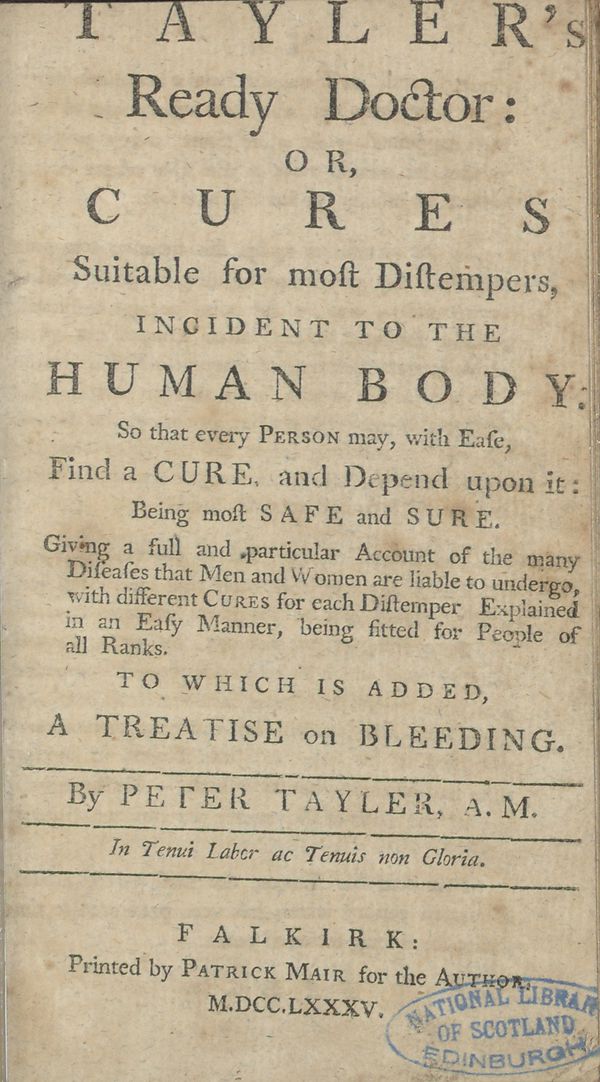
All I wanted to do was have a quick look at the National Library of Scotland's online resource of Chapbooks Printed in Scotland, just to see if I thought it would be of interest to History Girl readers.  And it is.  Fascinating historical chapbooks, printed in the 18th and 19th centuries, in 42 categories (from Accidents and Apparitions to War and Wit and Humour) are reproduced page for page.  But then I made a terrible mistake - I clicked on Diseases, and then on Tayler's Ready Doctor (published 1776) - and time passed ...


For a Greedy Appetite
Pottage of Wheat and a little Whale Oil boiled therewith; repeat this once a day for three days; or, apply Gum Arabic to the Belly.  If none of these will cure, the Patient's Case must be desperate indeed.

For Beardiness
... if you want to be free of a Beard altogether, the Blood of a Batt, once applied, will do the turn.

For Grief
Drink heartily of Balm and Mint Juice ...

For the Hickup
... Stop both your fingers in your ears, until you count to Fifty and Five regularly ...

Do you have an addictive nature?  Then perhaps you had better stay away from this site.  Think you're hard core enough to handle it?  Good luck and see you later.  Much, much later ...


Joan Lennon's website.
Joan Lennon's blog.
Silver Skin.

Thunder Powder, Phantasmagoria, and Artificial Asses' Milk - by Katherine Langrish


This book has been in our family for a very long time; I remember opening it as a teenager and laughing over some of the contents with my mother, in whose bookcases I recently rediscovered it.  Published in this ‘improved’ edition in 1837, it is a compendium of all sorts of useful information and tips for every imaginable kind of domestic circumstance or emergency.  Do you wish to ‘increase the durability of tiles’? Prevent fishing lines from rotting?  Purify wool infested with insects?  Do you wish to ‘write both blue and red letters at once with the same ink and pen and upon the same paper’?  Do you wish to cure boils, burns, nosebleed, the hiccough, gout, gravel or jaundice?  How about advice on how to prevent accidents from leaving a poker in the fire (weld a small iron crosspiece to the end of the poker, so that it will catch on the fender, should it slip out) – or on how to ‘make Transparent Screens for the Exhibition of the Phantasmagoria’? 


Our ancestors lived dangerously, it seems. In 1837, Charlotte Bronte was nineteen. Much wonder has been expressed that she and her sisters in their quiet, remote parsonage, should have been able to construct such passionate and dramatic imaginative worlds.  All right: but this little book, if they had possessed it, would have encouraged them to attempt amusements such as these:


Thunder Powder

Take separately three parts of good dry saltpetre, two parts of dry salt of tartar and pound them well together in a mortar; then add thereto one part, or rather more, of flower of brimstone ... put this composition into a bottle with a glass stopper, for use.

Put about two drachms of this mixture in an iron spoon, over a moderate fire, but not in the flame; in a short time it will melt and go off with an explosion like thunder or a loaded cannon. 


Such fun!  Or Charlotte, Emily and Anne could have written their books with:


The Phosphoric Pencil 

Is a small bit of phosphorus, put into a quill, and kept in a phial, in water; when you write, dip your pencil often in the water, to prevent its taking fire. 


It was possible also to make your own matches by ‘mixing one part of flower of sulphur with eight of phosphorus’: the author warns however:


This requires caution, and should afterwards be handled with great care, lest any part of the mixture get under the finger nails, a small portion of which might occasion great inconvenience. When used to procure a light, a very minute quantity is taken out of the bottle on the point of a match, and rubbed upon cork or wood, which produces an immediate flame.


A 'small portion of which might occasion great inconvenience' sounds a suspicious understatement to me. 'Hurts like h-ll', more probably...  Conditions in homes may be guessed at by entries such as these: “A mouse trap, by which forty or fifty mice may be caught in a night’ (a see-saw placed at the edge of the dresser, baited with butter and oatmeal, which tips them into a bucket full of water where they drown). A receipt ‘To destroy Bugs’ is also illuminating:


The risk of bugs in a big city is inevitable; the clothes-boxes of servants, the going to a public place of in a public carriage, or the insect being blown against the apparel while walking the streets, may introduce it into the house. But to cleanly people, whose beds are examined, and the joints oiled with pure sweet oil three or four times a year, they cannot become troublesome; except what no person can guard against ... a filthy, though perhaps very fine predecessor, who has permitted the animal to entrench itself in the walls and the ceiling. 


The only solution then is to seal up the fireplace, windows and doors, and fumigate the rooms with ‘vitriolic acid gas’...


Do you wish to make artificial Asses’ Milk?  Then take: 


Two ounces of pearl barley, two ounces of hartshorn shavings, three ounces of Eringo root candied, nine garden snails; boil these in six quarts of spring water till it comes to three; put two spoonsful of cow’s milk into half a pint of the above, and drink it lukewarm about half an hour before you rise in the morning. 

NB – You may leave out the snails if you do not like them, but it is best to use them.


Were you, like me, hoping all through this recipe that the Artificial Asses’ Milk was going to be used as a toilet water, rather than as something to drink?  I love the footnote. 


‘For improving coffee’ – ‘To discover vitriol in Beer’ – ‘To discover if bread is adulterated with alum’ – ‘To cure smoky chimneys’ – ‘To preserve meat by treacle’ – this enchanting book goes on and on. I shall share some more with you another time, but will leave you for the moment with this:


Vulgar Error respecting the putting of Spirits into Boots and Shoes to prevent the Effects of Cold

The custom of pouring brandy into the boots or shoes, when the feet have got wet, with a view to prevent the effects of cold, is a practice which (though very common) is founded in prejudice and misconception, and often proves fatal, by bringing on an inflammation and consequent obstruction of the bowels.