Showing posts with label Daughters of Time. Show all posts

Beaux on the Stage

by Marie-Louise Jensen

I've always been fascinated by the phenomenon of men sitting on the stage during performances and disrupting the play, and read more about it when I researched my short story, A Night in the Theatre, for our History Girls anthology.
I'm very far from being an expert on the Restoration period and the theatre (though I would love to learn more) but I understood a few things much better from what I did read.
So how and why did the Restoration theatre-goers (and later) put up with fine bucks on the stage making a nuisance of themselves and disturbing the action?
I think the first thing to bear in mind was how different the stage was. It was much bigger and had a huge, wide apron that sloped down towards the audience. So there was more space for this practice than there would be now.
Secondly, going to the theatre was a more general entertainment experience than just watching the play. It was not generally considered to be a high point for drama. You went for the afternoon, you socialized, you showed off your new clothes, you ate and drank and there were even prostitutes on offer. Not just the actresses, though some of those fell into the trade too, as is general knowledge and no end of displaying of charms and intriguing went on in the dressing rooms, to which 'gentlemen' were admitted.
Often the men in the pit were so noisy that you couldn't hear the play, let alone the men on the stage itself. Sword fights regularly broke out and everyone else had to scramble for safety.
For many, the play itself was fairly incidental. But not for everyone, and audience grew steadily more annoyed.
In the 1700s, a dramatic satire, called Lethe by David Garrick, was performed at the Theatre Royal in Drury Lane. There is a wonderful dialogue about beaux on the stage from the point of view of one of them:

Aesop: How do you spend your evenings?
Fine Gentleman: I dress in the evening and go generally behind the scenes of both play-houses; not as you may imagine to be diverted with the play, but to intrigue and show myself - I stand upon the stage, talk loud and stare about, - which confounds the actors and disturbs the audience; upon which the galleries, who hate the appearance of one of us, begin to hiss and cry "off off!" while I, undaunted, stamp my foot, so, take snuff with my right hand and smile scornfully - thus. This exasperates the savages, and they attack with vollies of suck'd oranges and half-eaten pippins.
Aesop: And do you retire?
Fine Gentleman: Without doubt if I am sober - for orange will stain silk and an apple may disfigure a feature.

Garrick finally banished spectators from the stage in 1763 - not before time!


Time and Boudica's Daughters - Katherine Roberts

Tomorrow, Templar will publish our very first History Girls anthology Daughters of Time, edited by Mary Hoffman, with short stories from authors of this blog who write for young readers:


My story is first in the book by virtue of being about the 'daughter' who comes first on the historical timeline - Boudica, warrior queen of the Iceni - so I'm sneaking in here a day before publication to write one of the first posts on the book's blog tour.

Boudica's story is a brutal one, containing material at first sight unsuitable for younger readers - both her daughters were reported to have been raped by the Romans, but rape is obviously not something I could include in a children's book, so my first challenge was to work out how to tell the story without losing its power.
 
This is not the first time I've written a short story about the queen of the Iceni. My first attempt "Empire of the Hare" was published in a small women's literary fiction magazine QWF in 1998, when it was also shortlisted for the Library of Avalon Geoffrey Ashe Prize.


In this version, which was published for an adult readership, I used the elder daughter to tell the story and had her fall in love with the Roman tax collector, meaning that she had already lost her virginity behind the stables with her Roman sweetheart before the rape scene. This was long before the days of ebooks, when Boudica was spelt Boudicca (and sometimes still Boadicea - the spelling in common use when I first came across the red-haired warrior queen at school, and therefore always the most romantic one in my mind). I also named her daughters differently, since this was pre-internet days and no popular names existed to confuse people... or if they did, I was not aware of them. Historically, of course, the girls' names are not recorded, and neither is the queen's childhood name - she received her popular name Boudica, which means 'Victory', when she led her people against the Romans.

statue of Queen Boudica in London

The young readership Templar proposed for Daughters of Time gave me the perfect opportunity to use Boudica's younger daughter to give the story a new slant. In "Tasca's Secret", my heroine Tasca is removed from the violence before it begins by her young Roman friend Marcus, who sneaks her into his father's camp when the soldiers attack Boudica's village. The younger daughter is therefore held as a hostage but not mistreated. Later, when the queen captures Marcus to take her revenge, Tasca defies her mother to save her friend.

If you know a young reader who has been inspired by Queen Boudica's story, I came across a wonderful illustrated poem about her over at History for Kids, which is written with the same age group in mind and uses humour to brighten up the history.

To me, this is one of the joys of writing historical fiction. There is always a new way into an old story - whether it is a different viewpoint, or a fictional character (such as the boy Marcus in "Tasca's Secret") who can be introduced to breathe new life into historical fact, or a different style that can be used to tell it. There is even a bit of leeway with well-known historical characters, especially if their ages are flexible, as with Boudica's daughters.

I know the other History Girls who contributed to this anthology have taken their own unique route into their chosen stories, which they'll be telling you more about at various stops on the blog tour. I, for one, am looking forward to reading all the stories when the anthology is published tomorrow!

~~~

Daughters of Time (edited by Mary Hoffman) includes stories by Penny Dolan, Adele Geras, Mary Hoffman, Diane Hoffmeyr, Marie-Louise Jensen, Catherine Johnson, Katherine Langrish, Joan Lennon, Sue Purkiss, Celia Rees, Katherine Roberts, Anne Rooney, and Leslie Wilson.

Katherine Roberts writes historical fantasy and legend for young readers. Her latest series Pendragon Legacy about King Arthur's daughter is also available from Templar. More details at www.katherineroberts.co.uk


Mary Anning in My Mind - Joan Lennon

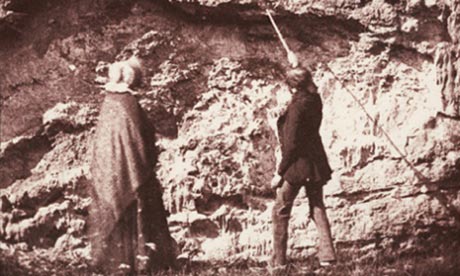
Mary Anning (1799-1847) was a fossil finder along England's Jurassic Coast, during the earliest days of the new science of paleontology. The theme on History Girls this month is Cranky Ladies in History, and Mary certainly had plenty of reasons to be unhappy, fed-up, angry, obstreperous, or, indeed, eccentric. (Tricky, these transatlantic translations ...) She had money worries, serious health problems, and more than her fair share of griefs, and she was under-valued by a scientific community made up largely of rich guys with beards. There are very few contemporary images of her other than the ones below:

sketch of Mary Anning by Henry De la Beche


painting by B.J. Donne (Mary is meant to be pointing at a fossil, not telling her dog Tray to stay)

Salt print photograph by William Henry Fox Talbot ("The Geologists" 1843) which may or may not include Mary Anning as the lump on the left (see Suzanne Pilaar Birch's article in the Guardian here.)

But the thing is, none of these images is a bit like the one of her I have in my mind.  I've been crazy for fossils for as long as I can remember, and I've had a soft spot for Mary Anning for about as long.  Which is why, when the chance to write a story about her in the History Girls' anthology Daughters of Time came along, I jumped at it.  I did my research.  I found out things I hadn't known before.  I felt sorry for all her troubles and trials and frustrations.  I was in awe of her (self)learning and meticulous skill in separating her fossils from the surrounding rock and her revolutionary understanding of their meanings.  But still that was not what I saw in my mind.  For me, Mary Anning will always be a figure running along a shingly beach, with a hammer in her hand and a dog at her side and the next amazing discovery waiting for her in the rocks just ahead.  The girl who could see things that other folk couldn't - exciting things - wonderful things ...  So that's how I wrote her.


Mary Anning:  Best After Storms


Joan Lennon's website.
Joan Lennon's blog.


P.S.  Back in 2010, the first Slightly Jones Mystery was published, all about the theft of the astonishing (and sadly fictional) dragonfish fossil from the then-new Natural History Museum in London - and this is the dedication:

Everybody's heard of Florence Nightingale 
and David Livingstone.  These books are dedicated 
to the Victorian heroes and heroines 
who aren't quite so famous!

This one's for 
Mary Anning, Fossil Finder


Prescient, eh?

Cranky Ladies of History

Sometimes we have a theme running through our posts for a month. Since this March, International Women's History Month celebrates Women of Character, Courage, and Commitment, and March 8th, International Women's Day, has the theme Inspiring Change, we are linking to a site that is attempting to crowdsource a book on Cranky Ladies of History. The editor of the book will post about it here on 22nd March.*

Not all our posts will be about this and we have had some discussion about what "cranky" means and interpreted it in our own way.

It links in well with our launch of Daughters of Time, which I wrote about on the first day of the year. That contains thirteen stories by members of the blog suitable for young readers of nine years and upwards, about women in English history, some whom might have been considered "cranky" in their time according to one or other definition.

My own choice, Lady Jane Grey, was not, in my opinion the helpless pawn of ambitious men and their political manoeuvrings. She was stubborn as a mule. After all, she could have saved her life by converting to Mary Tudor's religion but refused to - a rejection of clemency which saw her executed in the Tower of London.

Other contributors will write about their own "daughter of time" this month and next.


And four of us will be appearing at the Oxford Literary Festival to talk about the women in our stories, including Mary Wollstonecraft, Emily Davison and the protesters in the Peace Camp at Greenham Common. If you're in the area, do make a date for 2pm on Sunday 30th March.

Here I am putting flowers on the grave of Aphra Behn, who features in the book in a story by Marie-Louise Jensen:
We did this a few days ago in Westminster Abbey, following Virginia Woolf's advice:

“All women together ought to let flowers fall upon the tomb of Aphra Behn, for it was she who earned them the right to speak their minds.” (A Room of one's own) Seven History Girls came here with our publishers from Templar Books, who had organised the bouquet.

And we are pretty good at speaking our minds.

Eva Reckitt


But here I'd like to write about my own "cranky lady'" Eva Reckitt, in whose house I lived for four and a half years and who was a very influential person in my life. Obviously in that time I got to know her quite well, although she was eighty when I met her and I was twenty-five. But when I searched the Net for her there was only one rather unflattering photograph taken in her youth and some stern reports on how her phones were tapped and an official eye kept on her in the '20s because of her political affiliation.

For Eva was that oddity: a communist and a wealthy woman. Her fortune came from the family firm that made Reckitt's Blue - a phenomenally successful wash day aid used in lots of homes. Her older brother Maurice was an Anglo-Catholic writer and croquet player; her younger brother Geoffrey, known as "Bunny", was I think already dead when I met Eva.

She was born in 1890 and never married, though she spoke very warmly of the Socialist and academic G.D.H. Cole. Cole was married and indeed co-wrote many detective novels with his wife, Margaret Postgate. But I think Eva carried a bit of a torch for him.

Her main claim to fame, apart from generous donations to the Communist Party, was setting up the Collet's Book Shop in Charing Cross Road:


She was also on the executive of the LRD (Labour Research Department) and she was still going to meetings there when I knew her in the '70s. Her great friend was Olive Parsons and they shared a weekend cottage in Sussex. Olive, another committed communist and by then a widow, had also come under surveillance.

Olive's daughter-in-law was the poet Patricia Beer, whom I met in Eva's house and liked very much. (I remember staying up all one night in Eva's house to read Mrs Beer's House, Patricia's account of her childhood in a family of Plymouth Brethren, which antedates Oranges are not the Only Fruit by seventeen years).

So what was I doing in Eva Reckitt's house? I suppose I was her Companion. I got a free almost self-contained flat at the top of the house, in return for walking her cavalier King Charles spaniel night and morning and doing some gardening (always also rewarded with a curry lunch) and generally helping out.

We had breakfast together every morning, sitting under her painting by Roger Fry of Mediterranean rooftops. after I had taken the dog for a walk on Hampstead Heath. Later my husband-to-be also moved in and we were married from there, Eva coming to our very small wedding in Cambridge in a cold and frosty December.

I wrote my first book in her house. She taught me to have friends of all ages, so that one wouldn't outlive them all (Eva was 86 when she died, Olive 104). She introduced me to the Bookseller, a journal I still take every week, the Wine Society, William Morris - oh. so many things! Many a night she would invite me - later both of us - down to her living-room to watch a TV programme - a drama or an Arts documentary - while sharing a bottle of claret with her.

We still use some of her phrases and made-up words (she always went to the "hairmonger" for instance). She was both a thorn in the side of the British establishment and the most wonderful friend and companion. When she died, she left me a bowl by Lalique, a walnut bureau and a marble tiger, given her on a trip to China. To my husband she left her Nonesuch Shakespeare in seven volumes.

I loved her like a grandmother (I never knew a grandmother) and treasure her memory. So she is my "cranky lady," my woman of character, courage and commitment and one who inspired much change and development in me.

* Pozible Campaign
Roundup page on FableCroft


This post is written as part of the Women's History Month Cranky Ladies of History blog tour. If you would like to read more about cranky ladies from the past, you might like to support the FableCroft Publishing Pozible campaign, crowd-funding an anthology of short stories about Cranky Ladies of History from all over the world.


FAIR PHOENIX BRIDE… ELIZABETH STUART – Dianne Hofmeyr

© National Portrait Gallery, London
Elizabeth, Queen of Bohemia
by Unknown artist
oil on panel, 1613
30 7/8 in. x 24 1/2 in. (784 mm x 622 mm)
Purchased, 1982
NPG 5529
What a painting – the sumptuous brocaded silk, the diamonds, the pearls big as doves’ eggs, (how many divers drowned gathering these?) the stiffened collar, (how many maids dismissed for spoiling the lace with too hot a tong?) the elaborate hairstyle, the nipped in waistline, the hint of a farthingale, the strands of pearl necklaces (perhaps the ones inherited from her aunt, Elizabeth I?) the face suggesting a certain expectancy, the hunt of a smile curving the lips, serious eyes, the long aristocratic nose with its slightly heavy bridge that is noticeable in all her portraits, said to have been inherited from her mother, Anne of Denmark – as the Stuarts had rather pudgy noses.

When I look at Elizabeth Stuart in this painting of 1613 (for those of you who like a timeline painted just 41 years before Fabritius’s painting in Donna Tartt’s The Goldfinch,) I sense it’s a face one no longer sees in the 21st century. Yet I searched through my own photo files and came across this 21st century girl in 15th century dress celebrating a pageant in Italy, who might have been her sister. The same mouth, the same nose, the same eyes and this changes Elizabeth Stuart into real flesh and blood for me.


The portrait of Elizabeth is particularly poignant as it was painted when, within the space of a few weeks she’d lost her adored older brother, Prince Henry, heir to the throne of England, and she’d married Frederick, Elector Palatine of the Rhine, a boy she was hopelessly in love with. Not quite Four Weddings and a Funeral but still a time of huge emotion for a sixteen year old – a beloved brother dead of typhoid, a new husband and a voyage to Europe which would take her away from England forever.

But Elizabeth was used to matters of life and death. She was nine years old when a group of Catholic radicals plotted to blow up the Houses of Parliament to kill her father James I and her brother Prince Henry, and then planned to abduct her and put her on the throne as a Catholic queen. Fortunately their plans were foiled. In the portrait she is dressed with all the grandeur of a young woman who could well have become queen of England, albeit a Protestant one, if her sickly younger brother Charles, who limped from childhood rickets, stammered and was acutely shy, hadn’t lived to become King Charles I.

When I made enquiries about portrait NPG 5529 at the National Portrait Gallery, Catharine MacLeod
 Curator of Seventeenth-Century Portraits had this to say:
“The jewels that appear black in the painting, notably in her hair and in the large setting on her chest are most likely to be diamonds, which are conventionally shown as black in portraits of this period (partly because they were set in such a way that light did not pass through them as it usually does in the kinds of claw settings most commonly used today). The black oval on her shoulder appears to be a black enamelled locket, probably containing a portrait miniature; the black setting suggests that this might be a miniature of the recently deceased Prince Henry. “

I suggested that the white feather in her hair might have been a tribute to him as the Prince of Wales, but it appears not. She wears an armband of mourning and her standing collar and the lace around her neck have the lion and the unicorn, as well as fleur-de-lys and the royal coat of arms, all of which allude to her British (both Scottish and English) royal status.

My story, The Phoenix, for the anthology, Daughters in Time about to be published by Templar, draws on the poem written by John Donne to celebrate the marriage of Elizabeth to Frederick. Donne’s line: ‘Up then fair phoenix bride, frustrate the sun,’ suggests her spirit.

For me this spirit is epitomised in a much earlier miniature of Elizabeth. painted by Nicolas Hilliard. I like to think of it as the one she might have sent to her suitor Frederick in Heidelberg via the English ambassador. I can’t prove this but why be a writer if we can’t imagine.

The portrait shows her looking directly into the eyes of the beholder wearing a simple velvet carnation­-coloured dress, her hair hanging loose and wild… as if to say: this is me… this is what you’ll get. 

One can believe that this is the true Elizabeth. Feisty and strong-willed. The girl who persuaded her father to choose not a wealthy old grump from a list of ten possible suitors but the young man she herself had fallen in love with. The girl who dressed as a boy in order to gain entrance into her brother’s forbidden sickroom. The sixteen year old who married – despite court protocol for elaborate hairstyles – with her hair wild and untamed down her back plaited with tiny jewels and pearls and walked up the aisle at Whitehall smiling into the arms of her beloved sixteen year old Frederick to become eventually the Queen of Bohemia.

www.diannehofmeyr.com

Read the story of Elizabeth Stuart in:
DAUGHTERS OF TIME
By The History Girls Edited by Mary Hoffman
£7.99 Paperback, 9 + years 978-1-84877-169-7 March 2014
Written by some of today’s most exceptional female children’s authors, Daughters of Time is an anthology that shines a new spotlight on extraordinary women in history.

‘“History is about chaps" is still all too true a saying. So it's up to the fabulous History Girls to balance this approach with stories of impressive and inspiring women and girls - we were spoilt for choice.’ - Mary Hoffman

History tells us that there have always been brave, challenging and inspirational women, but unfortunately their stories are often overlooked. Publishing in March 2014, Daughters of Time brings back to life the tales of these remarkable women, helping to inform young people of how women and girls have been important in shaping the world we live in today. Written by a collection of established and bestselling children’s authors who all blog with The History Girls.

A big fanfare by Mary Hoffman


This is a really big day on the History Girls blog, so I hope you are not too hungover to focus! I can now announce with great excitement that we have produced our first ever publication. Daughters of Time will be published by Templar on 1st March 2014 and is a collection of stories written by some of our number about remarkable women, from Boudica to the protestors at Greenham common.

It's intended for readers of 9+ years and so our contributors are thirteen of those History Girls who write for children (some of us do both of course). It took a while after Templar approached us to work out which women we wanted to cover and who would write about whom but by the beginning of the year we had an outline that has now morphed into a book that is at the printer's!

Of course we could have done it all differently: there were so many subjects to choose from. So we have added a list of further women for readers to explore.

The anthology sprang from a post by Adèle Geras, a History Girl who was writing about the influence of the book Our Island Story on a whole generation of children. In the comments, another History Girl, Louisa Young, suggested that we should create a modern version of Our Island Story, with each of us writing one story and Adèle editing it.

An illustration from Our Island Story by H.E.Marshall

Adèle quickly rejected the editing suggestion but the idea of our producing an anthology one day got itself lodged in a few minds and Templar enterprisingly called our bluff. After that, the rest was details. Oh, and writing it of course, but it's always like that with books (I currently have one announced in another publisher's catalogue consisting of a title and cover and not yet much else).

In the end, I edited Daughters of Time and a dozen other History Girls contributed to it with me. Adèle's story was about Eleanor of Aquitaine, a very remarkable woman indeed, who was Queen of first France and then England. But we see her here in a private capacity, comforting a sick girl.

Eleanor of Aquitaine

We begin with Boudica - or rather with her resourceful and brave daughter, written about by Katherine Roberts, move on to Aethelfled, a rather less well known ruler, who was daughter of Alfred the Great and inspired Sue Purkiss to write her story, Lady of the Mercians. But it's not all about royal women.

We have Kath Langrish's touching story of the unhappy maid to Dame Julian of Norwich, Dianne Hofmeyr writing about Elizabeth Stuart, who escaped being both victim and puppet of the Gunpowder Plot and Marie-Louise Jensen on playwright Aphra Behn.

Mary Wollstonecraft, by John Opie

Penny Dolan introduces us to Mary Wollstonecraft and Joan Lennon takes us back to the childhood of fossil-hunter Mary Anning. Catherine Johnson completes a trio of Marys with the one called Seacole, a heroine of the Crimean War. Celia Rees writes about Suffragette Emily Davison, Anne Rooney about daring aviator Amy Johnson and Leslie Wilson - from her own experience - about the women anti-nuclear protestors of Greenham Common.


So a pretty varied bunch of subjects. I chose Lady Jane Grey, to liberate her reputation from the passive victim as portrayed  by Paul Delaroche in the famous and inaccurate painting of 1833, now in the National Gallery in London.

The Execution of Lady Jane Grey
I wanted to show how much she was still in charge of her own fate, however much the powerful men around her wanted her to be their political pawn. As a sixteen-year-old with a mind of her own and a will of steel.

In many of the stories, History Girls have introduced and created young women alongside the historical figures, to provide a way in for young readers, allowing them to see through the eyes of girls from the Middle Ages to the end of the 20th century, who found themselves part of events bigger than themselves.

We are launching Daughters of Time at the Oxford Literary Festival on Sunday 30th March at 2pm, when I will chair a panel consisting of Celia Rees, Penny Dolan and Leslie Wilson. And there will be several other contributors there to sign copies. We hope to see you there but, if you can't make it, then we hope you will read the book.


Daughters of Time by The History Girls, Edited by Mary Hoffman Templar, £7.99 paperback,
ISBN: 9781848771697 March 2013.

Now also available on Kindle. (updated June 2014)

For further details and review copies, please contact Laura Smythe on laurasmythecontact@gmail.com or 07881555530

Mary Hoffman and The History Girls are available for interview