Showing posts with label Mark Rylance. Show all posts

Stand in line - Michelle Lovric


description

Here's an almost entirely gratuitous picture of Mark Rylance, the thinking History Girl’s posset.

Just for your pleasure, and mine.

Please excuse the slightly intoxicated tone of this blog. I’ve only just finished watching Wolf Hall, and I am in love with every subtle crevice of Mark Rylance’s face.

When I informed Mary Hoffman of this parish about the new heart-fluttering inside my bodice, she told me tersely, ‘Stand in line’.

And when I mentioned it to Lucy Coats, history writer and fellow Guardian master class teacher, she snarled, ‘Stand in line. The whole internet is in love with Mark Rylance.’

I consulted a third researcher, who shall remain anonymous, only to hear that she nurtures a well accessorized fantasy in which she just won’t return all Mark’s calls and he is growing increasingly desperate. When I mentioned my own predilection for the doe-eyed boy, she growled, ‘Stand in line and take a number.’

I made a very small mouth.

I’m telling myself to sublimate, sublimate, sublimate. But all I can manage is snivel, and … substitute.

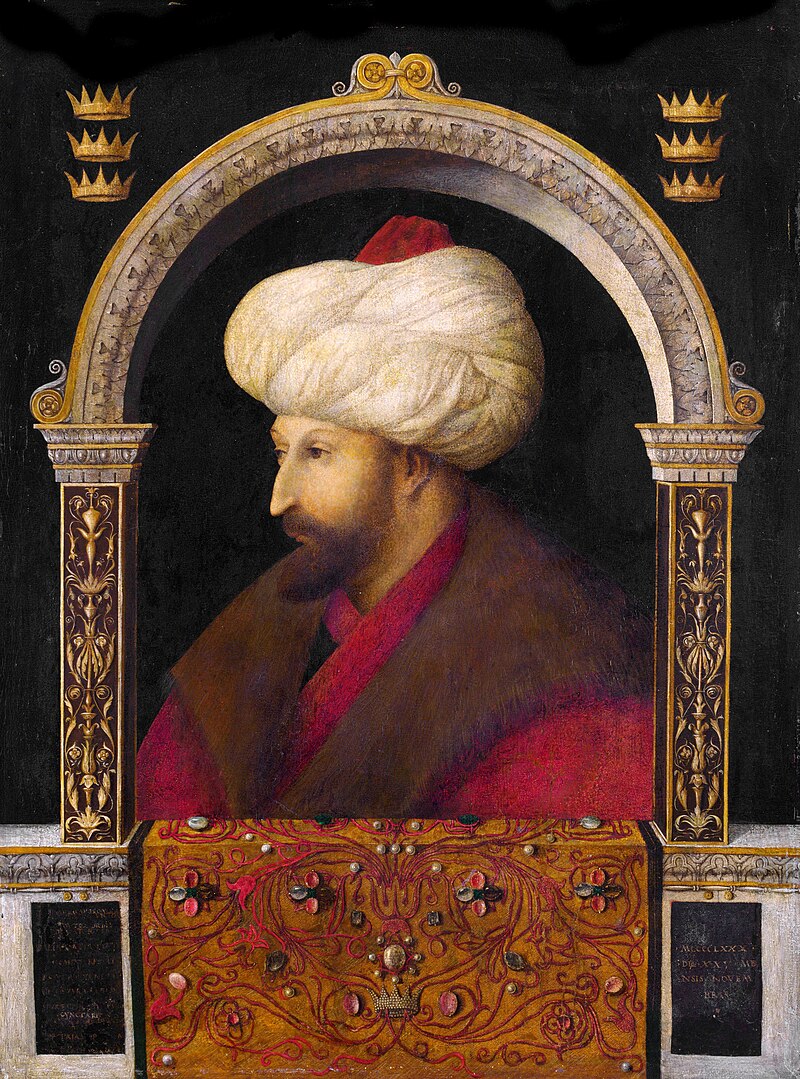
Apart from Mark Rylance’s, this is the face that draws me more than any other in the world and in time.
Gentile Bellini 003.jpg

It belongs to Sultan Mehmet II. It was probably painted by Venetian artist Gentile Bellini, brother of the more famous, more luminous Giovanni.

A framed print of this portrait has pride of place in one of three rooms I’ve recently reclaimed for the light in my London home. Long ago, fellow History Girl Laurie Graham, who is a genius with names, christened the two other bedchambers ‘The Princess Grace Memorial Suite’ and ‘The Joan Collins Annexe’. So this new room needed a name of its own too.


We have decided, for obvious reasons, to baptize it ‘The Sultan Mehmet II Mini-Suite’, especially given that its proportions are not exactly palatial. I would estimate that it could host only one substantial eunuch or two medium-sized concubines at any one time. And the latter would have to be on particularly good terms with one another.

The room is both Venetian and oriental in flavour, as also befits one focused on this portrait, which was created at the exact moment that Gothic architecture, with its Arabian arabesques and stone lace, was flourishing in la Serenissima.

Background detail only endears Sultan Mehmet II. He was born in 1432, ascending to the sultanate in 1451. He is famous for his restoration of Constantinople to its former glory after a century of siege, violence and dilapidation. He employed artisans from the entire known world to beautify his city. He loved Italian art and sought an Italian artist to paint his portrait.

His reign was a time of diplomacy between the Ottoman empire and Venice. Sultan Mehmet’s court for a time included Gentile Bellini, whose mission, starting in September 1479, was as visiting artist in residence and general cultural ambassador. Also part of the diplomatic effort was a mission was Bellini’s friend Giovanni Dario (whose house is now known as the most haunted in the city). I have also seen writings that suggest that the arches Bellini painted around the Sultan are based on those inside Giovanni Dario’s house. If this is true, it is a pleasant metaphor … the stones of Venice curve protectively and decoratively over the former enemy, sealing the peace with beauty.

The attribution to Gentile Bellini is not without controversy. Some have suggested that there are suspicious similarities between the sultan and a figure in Marco Palmezzano’s Jesus among the Doctors in the Temple.

This need not concern us here, any more than the fact that … I once saw Mark Rylance walking down my street near the Globe.

Mark Rylance is unavailable but we still have Sultan Mehmet II and that sultry profile.

Another reason to admire our Sultan is that he spoke Turkish and Arabic Greek, Persian, Latin, and Hebrew.

Plus, I present this picture of him smelling a rose.


The picture is taken from the Sarayı Albums Hazine 2153, folio 10a, courtesy of Wikimedia commons. How many men can be painted smelling a rose without looking faintly effeminate? All that emanates from this portrait is a delicate, appreciative sensuality. Only Mark Rylance could smell a rose as sexily as Sultan Mehmet could.

Sultan Mehmet II even looks good in coy three quarter view … as in this ‘alternative’ portrait from an unknown artist that was placed on Wikimedia Commons in 2011.


But I remain committed to Bellini portrait as the perfect representation of a fascinating man. If you want to see the original, you haven’t far to go. It’s at London’s National Gallery. The catalogue entry says, 'The painting is almost entirely repainted, especially in the figure. An old inscription, lower right, gives the date 25 November 1480. The lower left inscription is a more recent reconstruction; it includes the names Mehmet and Gentile Bellini … There is insufficient evidence for deciding whether the picture is a copy or a very damaged original.'

How did it get to London?

Succession time was dangerous in the Ottoman empire. Once can imagine the portrait smuggled out of the imperial chamber in the dead of night after the death of its protagonist. The painting may or may not have been sold in the Bazaar at Constantinople by the Sultan’s heirs. Thereafter it appears to have stayed in what is modern day Turkey for a few centuries.

Constantinople, or Istanbul was the posting of the eminent archaeologist Sir Austen Henry Layard, the man credited with making the bible true, by his excavations at Ninevah and Nimrud … the site of recent Islamic State atrocities against art.

It is said that Sultan Abdul Hamid II was unhappy when Layard was posted away from him in 1880 after a quarrel with Prime Minister Gladstone. Some sources claim that the sultan made a parting gift of this portrait to the exiting ambassador. Layard and his wife Lady Enid were shortly to settle in Venice, where they bought and restored a grand palazzo on the Grand Canal in the late 1870s. It became known as Ca’ Cappello Layard.

They moved their spectacular collection of Italian Renaissance art there and decorated the palace in sumptuous orientalist style. They were frightfully grand, as only English expats can be, with compulsory attendance at their soirees and parties by visiting luminaries.

Alternatively, there is the more picturesque version of the portrait’s provenance that one finds in John Julius’ Norwich’s excellent book, A Paradise of Cities. Norwich explains that Layard loved to tell the story of an anonymous man who accosted him in the street and tried to sell him the picture for the equivalent of £5. I love to think of it wrapped in brown paper with stained string. But the archaeologist refused, doubting its provenance. In the end, the man left the painting on the Layards’ doorstep like a foundling child. Layard was too grand to buy something that might have fallen off the back of a gondola, but he wasn't too fine to look a gift horse in the mouth. The painting was welcomed into Ca' Cappello.

Here is Sir Austen Henry Layard. Photograph by the London Stereoscopic Photographic Company, courtesy of Wellcome Images.


And here is his Vanity Fair caricature from Wikimedia commons. I'm posting it here because, unlike Mark Rylance or Sultan Mehmet, you won't find Layard at my house.


A nephew of Lady Enid recorded that the painting of Sultan Mehmet II was given a parrot for company at Ca’ Cappello Layard. One of the young boy’s duties was to go and cover the portrait with a green curtain at breakfast time, when the parrot performed ablutions that might otherwise have spattered the potentate.

Lady Enid’s copious diaries record many pet parrots. She even took them calling with her, and on holiday. She spoke of green parrots but their exact nature is not known. One was accused of giving her typhoid. Chains are also spoken of. This watercolour drawing of a ‘pet parrot on a perch’ (suitably oriental-looking) is from Wellcome Images.


There is a whole blog to be written about the parrots who lived with famous English expats and their friends on the Grand Canal at this point in time. But those birds are not kidnapping this one.

Henry Layard died in 1894, Lady Enid stayed on in Venice, continuing with a perfervid social life, entertaining Browning (whose parrot was called Jacko), Ruskin and royalty whenever possible.

The portrait of Sultan Mehmet II, like others in the Layard collection, was donated to the National Gallery after Lady Enid died in 1912.  But initially a 1909 Italian law on the export of art blocked the donation. Meanwhile Layard’s heir, Major Arthur Layard, pressed a claim for the Venetian portraits, based on an ambiguity of the wording of the will. Eventually he was compensated, and the Italian prime minister intervened to except the paintings from the export law. The dangers of World War I delayed the transport to London.

Sultan Mehmet II finally arrived on these shores in 1916 – and in my guest bedroom almost exactly a hundred years later.

 (Mark Rylance is also welcome at any time.)


Michelle Lovric’s website
the picture of Mark Rylance is from Wikimedia Commons
the original Sultan Mehmet picture comes from The Yorck Project: 10.000 Meisterwerke der Malerei, via Wikimedia Commons.

It's Wolf hall - again!

I know it's been over for some time and we've probably all watched Jonathan Strange and Mister Norrell since then. But I wanted to consider what a TV series does differently from a play, from a book. It doesn't have to be historical fiction but perhaps it illustrates the point best when it comes to visualising the scene.

I've read both Hilary Mantel's books about Thomas Cromwell twice, seen both the plays twice and seen the TV series twice (the last two episodes three times). I can't get enough of Hilary Mantel's creation but it does make me ponder on what the different media do for it.


First on TV the setting, costumes and props - these were all utterly convincing: the interior lighting by candles or fires, mullioned windows, all goods in chests, an illuminated prayer book dazzling in its colours because new. There was great attention to detail. (But see Liz Fremantle's February post for more on that and some reservations).

It's obvious that TV can do some things the stage plays couldn't do, giving us flashbacks to the boy Thomas Cromwell's brutal beating  by his thug of a blacksmith father - the motive to run away to the continent, with which the first book opens.

The TV series opened with the splendidly cast Bernard Hill as the Duke of Norfolk telling Cardinal Wolsey he is done for. The trouble with this excellent start was that we then had to go back to a period when Wolsey was still in the ascendant and could order Harry Percy and Thomas Boleyn around and tell them that Anne Boleyn had to go and marry someone in Ireland.

There was a bit too much of this "non-linear" narrative going on: the captions would have been more useful if they'd had actual dates rather than 'Four years before Wolsey's fall" and suchlike. No such problems with the books or the stage plays.

Wolsey himself was superb. Jonathan Pryce was not an obvious piece of casting: one thinks of him as tall and cadaverous rather than fat and jowly like a cleric who indulged too much in earthly pleasures. But he was very good indeed.

Then so was Paul Jesson on stage. But this is not an argument about who gives the better representation, pitting Mark Rylance against Ben Miles or Damien Lewis against Nathaniel Parker (the last another example of successful casting against type).

What interests me is what the different media can do with the same story. To take just one example - the masque pillorying Wolsey after his death. Hilary Mantel has taken "Cardinal Wolsey Going down to Hell," performed at the house of Thomas Boleyn (Anne's father) and transposed it to Hampton Court. The farce, presumably commissioned by Boleyn, was put on as an entertainment in January 1531, for the new French Ambassador, Claude de la Guiche. "The Duke," whom Mantel reasonably takes to be Thomas Howard, Duke of Norfolk, called for it to be printed.


The Ambassador was evidently not amused and according to Eustache Chapuys, the Imperial Ambassador, "much blamed the earl, and still more the Duke for ordering this fare to be printed." (quoted in Greg Walker's Plays of Persuasion: Drama and Politics at the Court of Henry Vlll (Cambridge University Press 1991)). Not surprisingly, since it portrayed a Cardinal tormented by devils and burning in hell.

Hilary Mantel takes this reasonably well known fact and makes of it something crucial to the plot of both her novels and one that offers an explanation for Cromwell's implacable persecution of the five men executed with Anne Boleyn. Each of the four "devils" is a nobleman (somewhat unlikely as actors in a farce, perhaps, but no matter). Cromwell watches them unmask and reveal themselves to be George Boleyn (Anne's brother), Henry Norris, Francis Weston and William Brereton.

In the novel of Wolf Hall this scene comes less than halfway through and the person taking the part of Wolsey himself is Master Patch, the jester whom the Cardinal gave to the king. In the play it's Mark Smeaton, neatly linking all five executed men to the farce.  Here in the novel  Mantel describes the reactions of the audience to the farce:

"Anne sits laughing, pointing, applauding. He has never seen her like this before: lit up, glowing. Henry sits frozen by her side. Sometimes he laughs, but he thinks if you could get close you would see that his eyes are afraid."

Crucially there is one dissenting voice at the "entertainment" - "Someone calls out 'Shame on you, Thomas Howard, you'd have sold your own soul to see Wolsey down.' Heads turn, and his head turns, and nobody knows who had spoken; but he thinks it might be, could it be, Thomas Wyatt?"

In Mike Poulton's playscript it is definitively Wyatt, who cries, "Shame! Shame on you, Norfolk! Shame!" But Wyatt is a major linking character in the plays and gets a more prominent role than in the books.

In the TV version, no-one cries "Shame!" at all. And that's a shame. It seems no-one at court is brave enough to stand up for the Cardinal, to whom Cromwell's intense loyalty is a constant motif, explanation and motive. In fact it turns into a bit of a Revenge drama, with Cromwell avenging his father-figure Wolsey, who was more benevolent to him than his own flesh and blood parent.

There is a scene where Cromwell watches the four "devils" take off their masks but it is somewhat wasted because of the casting. George Boleyn looks too like Brereton - or is it Weston? The point gets lost and has to be brought out in a later episode where Cromwell is interrogating the accused men in the Tower. If you hadn't read the books, I don't know if you would have "got" it. The whole scene is very brief on TV and there is no sign of Mark Smeaton.


But now we have three ways of "knowing" that at least four of the five men executed before Anne Boleyn took part in the Wolsey farce, does it matter that Hilary Mantel made this up? Surely, only if we come to believe this really is what happened?

Which brings us to the question of how we know our history; is it thorough reading historians or historical fiction. Do we believe that Elizabeth Woodville saved her son from Richard the Third, as Philippa Gregory tells us she did?

As Hilary Mantel says in the Author's Note to Bring up the Bodies, " I am not claiming authority for my version; I am making the reader a proposal, an offer."

As you may have gathered, although I enjoyed it, I liked the TV version less than the other two manifestations of Hilary Mantel's Cromwell stories. It may not be surprising that for me the books come first. There were a couple of show-offy moments on Tv which I positively disliked: Thomas stroking Anne Boleyn's breasts in a scene it took a moment or two to realise was in his imagination and the ridiculous dragging of her body along his dining-table with him about to stick the knife in. It was evidently too much of a temptation to make a metaphor literal.

And it lost a lot of the humour of the books and the plays; in the theatre everyone laughed when Leah Brotherhead said, "Oh, I'm nobody. I'm only Jane Seymour." There were many such touches, replaced on TV by Cromwell's sardonic remarks and occasional swearing.

Still, there was much to enjoy in the minor performances, such as Charity Wakefield's spirited and saucy Mary Boleyn - though it was hard to believe this one would have let Henry walk over her so. And one of my favourite characters, Eustache Chapuys was perfectly rendered by Matthieu Almaric. There was even an effort at his "startling hat" with which Hilary Mantel had such fun in Bring up the Bodies. Sadly, I could not find a picture of him wearing it.


I can't wait for the third book, The Mirror and the Light; the third play, with, please, Ben Miles and Nathaniel Parker, the third TV series, with Mark Rylance and Damien Lewis. I like Hilary Mantel's "offer" very much, in whatever form it comes. But best of all in the books.

What do you all think?


CAN WE TALK ABOUT WOLF HALL, AUTHENTICITY AND KNICKERS? – Elizabeth Fremantle


The airing of Wolf Hall’s small screen cousin has provoked a good deal of discussion: is it too slow; is it too confusing; is it too dark; wasn’t Henry fatter; wasn’t Cromwell more of a monster; is it accurate?

Mark Rylance with director, Peter Kosminsky (Radio Times)

The question of historical truth comes around again and again. The Imitation Game ruffled feathers for, amongst other things depicting Turing as possibly involved in (or knew about and turned a blind eye to) treachery when there is not a shred of evidence to suggest that this might have been the case. People have complained that there wasn’t enough science in The Theory of Everything, without stopping to think that the film is an adaptation of Jane Hawking’s book – it is her version of events not his. Mike Leigh’s Mr Turner provoked tumultuous critical delight over Timothy Spall’s snorting, grunting performance, which I personally found grotesquely over-played. ‘But he was supposed to be just like that,’ people cried in response to my criticism. ‘Based on what exactly?’ I asked. 

Anne Boleyn plus PA (Daily Mail)
We can get so wrapped up in the idea of accuracy that it is easy to forget such a thing is impossible. With Wolf Hall it’s all been about the authenticity, with costume designers talking about how they only used fabrics of the period and correct fastenings – mostly pins, in case you were wondering and not zips, which was the accusation levelled (hotly denied, I might add) at the recent White Queen adaptation. But, I ask myself are they all going commando because as all self-respecting Tudorphiles will know, knickers hadn’t been invented in the sixteenth century.

The ‘authentic’ lighting (mainly candlelight for interiors and nothing outside) has meant a good deal of viewers grumbling about not being able to see anything. ‘Ah but that is how it would have been,’ come the replies. That may be so but to our twenty-first century eyes, used to the brightness of the present, our response to it is jarring and confusing. A Tudor would not have responded in such a way; it would have been the norm, their eyes would have been accustomed to a dimmer world, more in tune with the seasons and fluctuating hours of daylight. What I’m trying to get at is that absolute authenticity remains out of reach, like Plato’s perfect forms, and to try so hard at it can be a futile project.

Rylance as Cromwell
Holbein's Cromwell
I like the gloom of Wolf Hall, not because of its historical veracity, but mainly because it works with the shadiness of its protagonist. Though unfortunately in some of the exterior scenes, shot in the gloaming it looks, on my brand new super-duper-HD TV, rather than atmospherically shadowy, depressingly redolent of low-tech BBC costume drama from the 1970s. But I sympathise with the intention even if the outcome is not necessarily wholly successful because I find myself noticing other things, like the puzzling absence of mud in the exterior scenes and the manicured gravel driveways and the dog that looked suspiciously like a cockapoo and Anne pronouncing his name (Purcoy) phonetically rather than the French way (Pur-cwa) as she would have. Now I'm just being a pedant and the point I'm trying to make is that none of it really matters; what matters is the effect it has.

Lewis's Henry VIII
Then of course there’s the question of Cromwell and his character. Views on this are polarised. A historian friend of mine believes Mantel’s Cromwell is too modern in sensibility. It seems to be Mantel’s project to explore the possibility that Cromwell was a remarkable self-made man, and yes, darkly complex and Machiavellian but not just, to borrow Dairmud MacCulloch’s term, ‘a thug in a doublet’; whereas revisionist historians seek to expose the Reformation, the promotion of which was Cromwell’s life’s work, as an act of monstrous destruction akin to the acts of fundamentalists in North Africa today. We will never find a definitive truth but what is good is that texts such as this open up discussion.
Rhys Meyer's Henry VIII

What a TV show like Wolf Hall is attempting to do is to set itself above the usual costume drama. It’s narrative is convoluted, it refuses to spoon feed us, makes us work hard, makes us think. It says ‘I am authentic,’ suggesting that Jonathan Ryhs Meyers in his hopelessly anachronistic, yet very fetching, faux-Tudor gear, is not – I couldn’t possibly comment. But when we watch TV we know that only a few feet away is a fellow with a big camera and that we’ve seen these actors in other roles, that they’re all pretending. We want to suspend our disbelief, we’re in on the sleight of hand, and do we care if they are wearing knickers? I suspect not.

Elizabeth Fremantle's Tudor novels Queen's Gambit about Katherine Parr and Sisters of Treason about the sisters of Lady Jane Grey are published by Penguin.

Find out more about Elizabeth and her books on elizabethfremantle.com