Showing posts with label 17th century. Show all posts

How to read as a writer, by Gillian Polack


There are so many articles these days – on the web and off- that give a guide to how life was lived or how something was experienced in times other than our own. We can fly through London in the seventeenth century, or boat down the Thames. We can hear about the theatre or read how someone cuddled up by the fire to a good book. What all these articles have in common is that they’re articles about something: they’re modern thoughts. 

For many writers, these articles are entertaining and fun, but not where we get the grit for our fiction. We delve into scholarly studies and we check primary sources. Primary sources are the best. Books, articles, pamphlets, ephemera, pictures, objets d’art, everyday items – any primary source. I use them so much that I keep forgetting to explain that the way I read them in order to write fiction isn’t at all the way I read them as a historian.

Today, then, I’m going to address two issues with the same example. I’m going to show you how I (as a writer) read a single primary source for my fiction. At the same time, I’m going to say honestly that this is not even close to the technique I use as a historian. 

History and fiction serve different functions. We research both, but the research can be quite different in style and always leads to different outcomes. This is one of the many reasons there is a difference between historically based fiction and scholarly monographs, after all. I look into this in detail in History and Fiction, but I don’t actually pull apart a primary source to use in a novel. If you want more of the theoretical stuff, and to know what other writers do, History and Fiction is the place to go. Here I’m going to take a source that I think might be of use for the novel I’m writing (slowly at the moment, for the universe keeps intervening) that’s set in the seventeenth century.


Samuel Pepys is very well known for his diary. He wrote it for himself, which makes it even more interesting, for he writes about his place and time in a very personal way. We’re often looking through his eyes when we see the Great Fire of London, for so many modern novels that tell of the Great Fire or that have it as an incident, use his accountas their basis. 

As a historian, I regard him as a tremendous primary source for his place and time. I also have to balance his very articulate views with those of others, because Pepys’ importance (both at the time and in our eyes) means that it’s all too easy to use him alone. To get an understanding of how people actually lived, therefore, Pepys only provides one small story.

Novels share that with Pepys. They, too, focus on one small story. It’s what we write. Accounts of places and of times that focus quite sharply on particular people or events. So many novels, therefore, rely heavily on Pepys. This is why he’s not one of my major sources for my novel, in fact. Pepys is the wrong gender for me, in an England where the life experiences of men and women were wildly different. I’ve read him through and taken the information I think I need from him, and then moved on to other sources that more closely meet the way my own characters would have seen their place and time.

When I read Pepys, I always remember that London was different before to after the fire. I took this picture in 2014 to remind me - this is definitely an 'after the fire' view.


This makes him a very good source to use as an example, for you can see how he’s useful and how he isn’t useful for my novel. 

Let’s start with what I’m looking for. I’m depicting the world of women. I’m looking, therefore, for experiences they might have had, for places they might have seen, for anything that’s shared between men and women, for hints of how my characters might see the streets of London when they visit. Unlike Pepys, they were not Londoners, so what he sees as an insider, my women would see as outsiders.

Let me use an online edition (although I used a print edition for the most part). I’ll paste it here and annotate it, with notes on how I would use it to help shape my novel. You might want to check the annotations of others, as well. They help show how modern readers look at Pepys and what they think need explaining for the wider public. You can find the diary entry and its reader-annotations here

 
Again, London in 2014. Even if the buildings change, the streets may be the same. Pepys may well have walked this.


Up, and to White Hall to the Committee of Tangier (1), but it did not meet. But here I do hear first that my Lady Paulina Montagu did die yesterday; at which I went to my Lord’s lodgings (2), but he is shut up with sorrow, and so not to be spoken with: and therefore I returned, and to Westminster Hall, where I have not been, I think, in some months. And here the Hall was very full, the King having, by Commission to some Lords this day, prorogued the Parliament till the 19th of October next (3): at which I am glad, hoping to have time to go over to France this year. But I was most of all surprised this morning by my Lord Bellassis, who, by appointment, met me at Auditor Wood’s, at the Temple, and tells me of a duell designed between the Duke of Buckingham and my Lord Halifax, or Sir W. Coventry; the challenge being carried by Harry Saville, but prevented by my Lord Arlington, and the King told of it; and this was all the discourse at Court this day (4). But I, meeting Sir W. Coventry in the Duke of York’s chamber, he would not own it to me, but told me that he was a man of too much peace to meddle with fighting, and so it rested: but the talk is full in the town of the business. Thence, having walked some turns with my cozen Pepys, and most people, by their discourse, believing that this Parliament will never sit more, I away to several places to look after things against to-morrow’s feast (5), and so home to dinner; and thence, after noon, my wife and I out by hackneycoach 6), and spent the afternoon in several places, doing several things at the ‘Change and elsewhere against to-morrow; and, among others, I did also bring home a piece of my face cast in plaister, for to make a vizard upon, for my eyes (7). And so home, where W. Batelier come, and sat with us; and there, after many doubts, did resolve to go on with our feast and dancing to- morrow; and so, after supper, left the maids to make clean the house, and to lay the cloth, and other things against to-morrow, and we to bed (8).

1. Places are handy. I can locate them on a map and decide if my characters need to pass them or visit them.

2. Individuals are less handy. Unless they’re likely to appear in the novel, their main use for me is to decide if my characters belong to their class or circle and how any reference will be made to them. In this case, I can’t see any reason for mentioning the death of Paulina Montagu, so I just keep on reading.

3. Pepys was a public servant and his life was ruled by Parliamentary sittings. My characters are anything but. I need to know when Parliament is sitting, however, for it will influence the visit to London. Also, it would be a great matter of interest to my characters. Politics in the late seventeenth century were an obsession and a matter of great import and terribly emotional. I will need a timeline of all the Great Events (including who betrayed whom and when) and I will need to know my characters’ views on these things. This mention by Pepys helps remind me that I need to do this. The wonderful thing about doing this as a novelist is that I’m allowed to be far more partisan than I can be as a historian. My characters will have Opinions. This means I develop quite a different timeline and overview to the one that I would develop as a historian, where I’d look more into causes and outcomes of events than into the feelings of women from a given region. To simplify, I can decide who someone would like to throw mud at and why.

4. Duels are terrific fodder. If there’s a duel in London when my characters visit and if there’s a reasonable likelihood that they’d hear about it, then it will be of interest. No more than that for me for this novel, however, for it’s not the stuff of my women’s lives. Pepys is much closer to the aristocracy and the doings of government than my women are. 

Place in society matters at least as much as place in time. The story Pepys tells would be a good one. A duel! How it happened! was stopped! But it can’t happen in that way in a novel with women from a country town as the main characters. The most they could do is gossip about it, or maybe know someone who knows someone. 

The drama has to come from something other than duelling, then, which is a shame, given how much we associate the seventeenth century with duels. I could force a duel in (as many authors do) but forcing the historically unlikely is not my style. In my notes I’ll probably write that I have to find something of equal interest, but that I can’t use a duel. It’s OK, though, for there’s at least one duel in a novel of mine that will be out next year – it’s entirely appropriate in that novel.

5. Food! I know what Pepys was likely to have eaten. Better, I know what my characters would enjoy. I’ve still got to test a bunch of recipes, but I have the tastes of the time and place all sorted. This means that Pepys isn’t giving me anything new, but he does remind me I still have to test recipes. This is one of the reasons the novel’s been put off for a bit – the one I’m writing currently has no recipes to test, so I can do it immediately.


6. Another thing I can check off. I have my transport to London sorted and my transport within London. I know how long it takes to get to a place and even how long it takes to get letters to and fro, in order to plan a trip. These were easy to research as there are books of timetables in the later seventeenth century. Some eras are much easier to research than others!

7. I do not want to know this. I really, really hate the thought of having a plaster cast of my face. It’s a suffocating scary squicky thought. I do know how it was done, however, should I ever need to write about it. 

Oddly, I was interested in this when I was a child and collected gypsum to make plaster of Paris. My mother forbade me to use the oven and my plaster of Paris remained unmade. This is the sort of information that helps with fiction. It’s much easier to check up the specifics of a technique than it is to find out about something of which one has no knowledge at all. I think this is why so many fiction writers are magpies in the way we collect an understanding of this or of that. Which reminds me that I’d make a note at this point about the ‘Change. This is something that will have to appear in my novel, in one way or another.

8. This sentence is the most important in the whole extract for my novel. It tells the normal order of life. This is something that men and women shared. It tells me the role of a maid (and that it’s a single maid and not three maids and a footman) and how she fits in with the house as a whole. I’ve done my homework on this – I know the shape of London households of this level of prosperity. This means I can safely use this sentence to help bring a household to life.

In Which I Enjoy a New Word by Joan Lennon

And the word is ...
pareidolia

This may be a term you use on a daily basis, but it was completely new to me.  It refers to that peculiar habit of the human brain to see faces, patterns, or meaning where they do not really exist.  Like the man in the moon, or a dragon in a cloud, or Madeline's "crack on the ceiling that had the habit of sometimes looking like a rabbit."  I came across it by a roundabout route.  It happened like this ...

A friend introduced me to The Public Domain Review - like the National Library of Scotland chapbook archive I warned you about, these are dangerous waters.  Almost immediately, I was sucked in by an article on anthropomorphic landscapes.


Athanasius Kircher (1645-6)


Flemish School (early 17th century)


Herman Saftleven the Younger (1650)

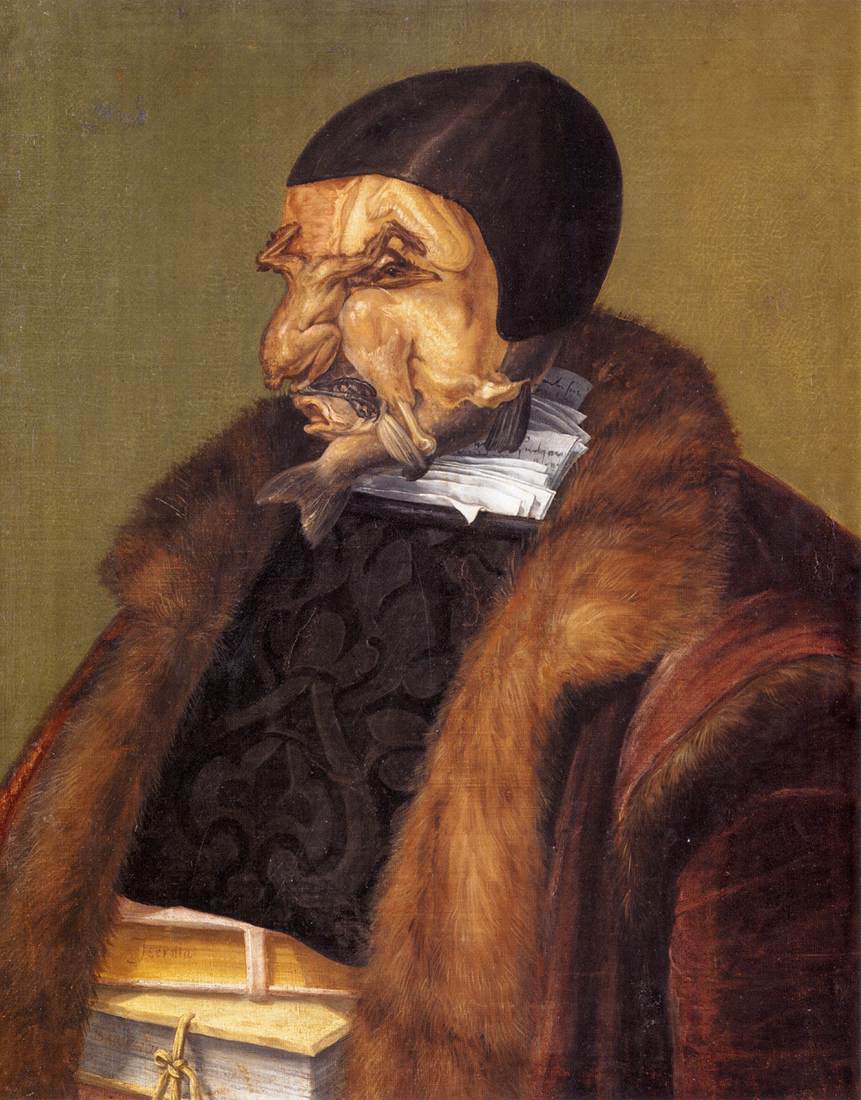
Which made me think of what Juan Sanchez Cotan did with vegetables at the beginning of the 17th century (I've raved about him here) which made me half-remember paintings of people made out of plants, so I wandered off in search of "17th century portraits of people made out of vegetables" and came to Guiseppe Arcimboldo, who turns the finding a face where one shouldn't really exist into finding vegetables/fish/books where they shouldn't really exist.  He fascinated his contemporaries with these insane portraits, and he fascinates us still.  (Interestingly he started out working with stained glass - I think you can see the influence of building with units.)


Summer (1653)


The Jurist (1566)

I also love the amazingly modern-looking Librarian which you can see here (I couldn't get a jpg image to copy over).

And it was while I was hanging out with Arcimboldo and vegetable paintings generally that I stumbled across my new word.  And did I then call a halt?  Did I completely refrain from checking out modern pareidolic images and the various humorous things one can do with a set of stick-on googly eyes?  Of course I did.  I am, after all, a History Girl. 

Do you have a favourite (historical, of course) pareidolic image, anthropomorphic landscape or portrait made out of vegetables?  If so, share a link to it in the Comments, and let the wandering continue.  And here's to new words and the delightful strangeness of the human mind!  


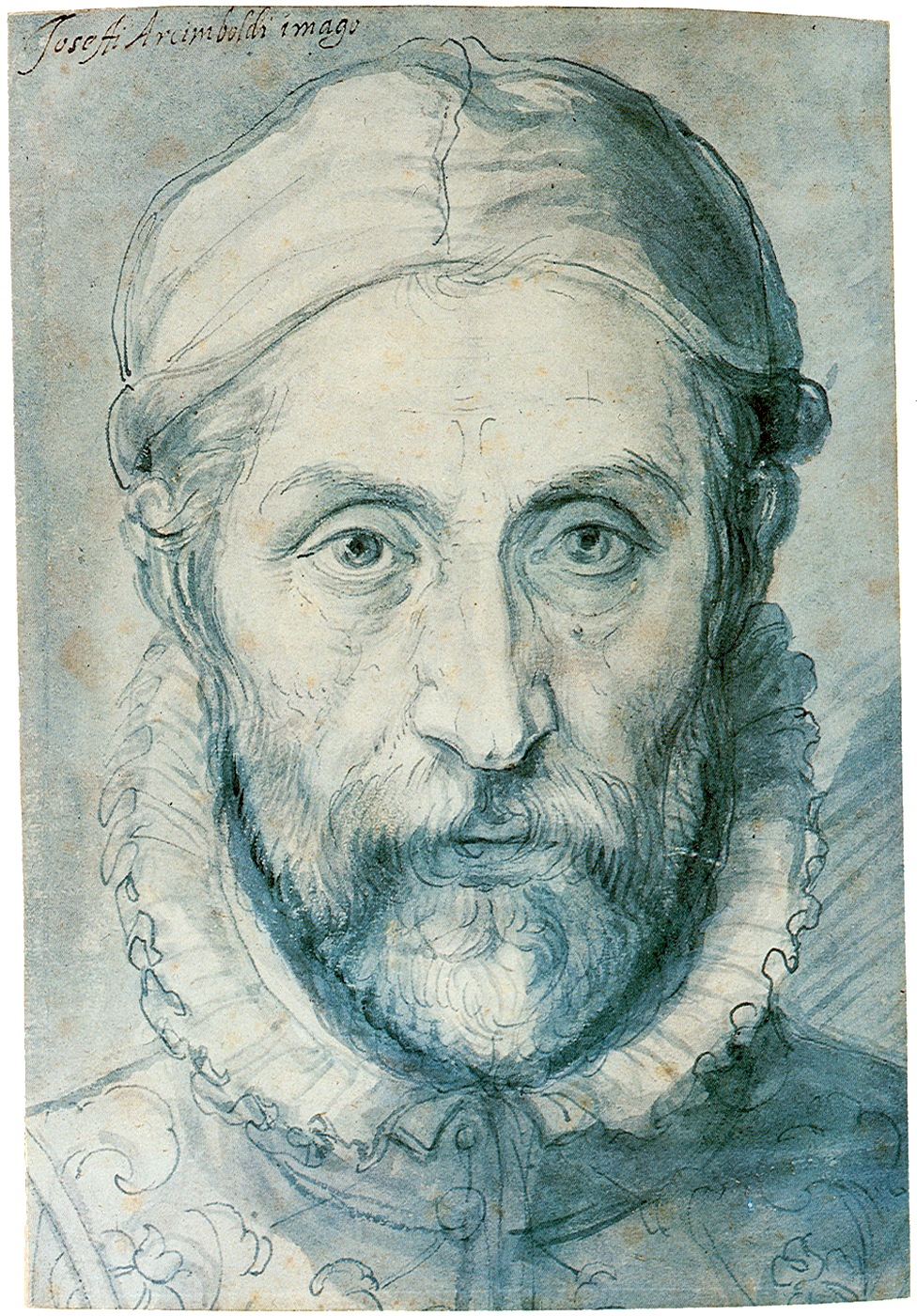
P.S.  This has nothing to do with anything pareidolic, but if this self-portrait is anything to go on, wasn't Guiseppe gorgeous!


Joan Lennon's website.
Joan Lennon's blog.
Silver Skin.

Medieval Weobley - by Ann Swinfen


The village of Weobley is one of the most beautiful in England.


However, lying as it does a mere four miles from the Welsh border, it has known troubles over the centuries, some arising from Marcher warfare, some due to wider national events. Today Weobley has retained a wealth of black-and-white medieval buildings, although some have been lost, and where the castle once stood on an eminence overlooking the village nothing is readily visible above ground but the castle mound and intriguing humps and bumps. Much of the valuable dressed stone from the castle building has found its way into village houses.


Artifacts from the Mesolithic and Neolithic periods have been found in the area, including a Neolithic polished stone axe produced by the Graig Lwyd ‘axe factory’ at faraway Penmaenmawr (North Wales), an indication of long-distance trading contacts. Bronze Age cup-marked stones and small metal objects have also turned up, suggesting that this extremely fertile, sheltered and well-watered spot has been occupied since earliest times. Settlement seems to have increased during the Iron Age, Roman, and Romano-British periods, a number of coins having turned up, mostly in the abandoned castle site. If there is other evidence it probably lies under the medieval houses which stand in the long occupied central portion of the village, and so are inaccessible.

It is in the Saxon period that Weobley truly enters documented history. The name Weobley is of Saxon origin and is recorded in the Doomsday Book as Wibelai, which means ‘Wibba’s clearing’. Wibba may have been the son of Cribba, first king of Mercia (late 6th century). A ‘lai’ or ‘ley’ was a glade or clearing in woodland, used for a settlement. The Ley is a sixteenth century house on the outskirts of the village.

The original form of the name as Wibelai perhaps accounts for the present-day pronunciation, which is ‘Webly’, the ‘o’ not being sounded. The pre-Conquest lord of Weobley at the time of the Doomsday Book (1086) is listed as Edwin. A priest is also recorded, so it seems there was already a church in the village. The Conqueror’s inventory of the lands he had seized indicate a flourishing agricultural settlement.

As a side note – we own a house on the banks of the brook which runs through the village. It seems that this was regularly allowed to flood in winter, thereby depositing silt washed down from the limestone Burton and Wormesley hills to the south, resulting in what is still an extraordinarily rich soil.

Weobley, with the surrounding area, was granted post-Conquest to William fitzOsborn, Earl of Hereford. (The city of Hereford is twelve miles to the south.) The family did not long remain in possession, for a rebellion by William’s son, Roger de Breteuil in 1074 was put down by Walter de Lacy, who then succeeded him as tenant-in-chief of the crown. He himself did not enjoy his lordship for long, as he fell to his death in 1085 from St Peter’s Church in Hereford while it was under construction. (Faulty medieval scaffolding?) His son Roger therefore held Weobley at the time of the Doomsday survey, and may have been the original builder of the castle.


Weobley was to see more war and rebellion. During the Anarchy, the struggle between the Empress Matilda and her cousin Stephen for the crown of England, Weobley Castle was held for Matilda in 1139. Stephen besieged and captured it in 1140, an experience which must have had a serious effect on the villagers. By the late 1180s, the castle was held by Matilda’s son, Henry II. The de Lacy family continued to be prominent in the area, although for a time they were mainly concerned with their lands in Ireland. More trouble was brewing, however.

The second Walter de Lacy married Margaret, daughter of William de Braose, lord of Brecon, who was one of the barons who rose against King John, using Weobley as his headquarters. It was from Weobley that he may have launched his attack on Leominster, burning the town, and it was while he was in Weobley that King John demanded that he should surrender and hand over his son as hostage. As a result of his father-in-law’s activities, Walter de Lacy lost his lands and only regained them in 1213, at which time (wisely) he probably rebuilt and strengthened Weobley Castle. This de Lacy went on to have a distinguished career as Custodian of Hereford Castle, and Sheriff of Herefordshire. In this latter role he implemented the new royal policy (alas, short-lived) of protection of the Jews.


While all this political strife was happening, the people of Weobley were getting on with their lives. By this time Weobley had become a flourishing market town, serving the neighbouring villages, as well as being the centre of a prosperous agricultural district. At some point it must have been granted a charter for an annual fair, since Walter de Lacy petitioned for a change to the date in 1231. The very wide central area of the village would have been eminently suitable for holding a fair, though the slope might have made the pitching of stalls something of a headache! It is likely that this same busy de Lacy may have laid out more properties in the village, to increase his income from rents. Weobley was on the rise.


By 1255 Weobley had its own jury in the court of eyre, which would be presided over by the king’s justices – the mark of its increased status as a borough. Weobley would no longer need to send its cases for trial in Hereford. Even earlier, a case in 1229 cites Weobley as a borough. And from 1295 to 1303 Weobley sent two Members to Parliament.

The powerful de Lacy family was to die out. When Walter died in 1241, his only heir was his granddaughter Margery, now married to John de Verdon, a family which has remained notable in the area down to modern times. The lordship of Weobley passed to John, then to his son and grandson (both called Theobald).When the younger Theobald died in 1316, the heir was again a woman, his daughter, another Margery, thereafter known as the Lady of the Manor of Weobley.

At the time of her inheritance, Margery Vernon was married to William le Blount, who was made joint heir in her father’s will. William died in 1337 and manor and castle passed to Margery and her heirs. As it was not normally the custom for a woman to hold a castle on her own, in 1338 she granted it for life to John le Blount, who may have been her brother-in-law. At some point Margery married a Marcus Husee, then in 1356 married for a third time, to John de Crophull or Crophill. If you do the sums, Margery was quite a remarkable lady. This third marriage was forty years after she had originally inherited from her father, when she was already married. How old was she? There is little information available about her second husband, but the Black Death occurred between 1348 and 1349, so he may have been a victim of it. Like everywhere else in Europe, Weobley is likely to have had a third to half its population wiped out.

On his marriage to Margery, John de Crophull took possession of her property, and on his death in 1383 left it to his granddaughter Agnes. Considering the way the manor and castle of Weobley was passed around, it seems as though Margery had no children, or at any rate none who survived. It would have been impossible (given what must have been her age) for Agnes to have been her granddaughter. It is curious also how often the heir to the manor of Weobley was a girl.


Agnes was under age when she married Sir Walter Devereux – it was not uncommon for a rich heiress to be married off as a child – but in 1386 Sir Walter was able to prove that she was ‘of majority’, so that he could claim ‘livery’ of her lands. As usual, the husbands of these women took control. Weobley therefore fell into the hands of the Devereux family (of whom more later). Sir Walter was killed on 22nd June 1402, fighting under the Marcher lord Roger Mortimer against Owain Glyndwr at the battle of Bryn Glas (not far from Weobley), during the reign of Henry IV – a battle mentioned by Shakespeare. Sir Walter’s tomb is in the church of St Peter and St Paul, Weobley.


Agnes, the Lady of the Manor of Weobley, then married Sir John Marbury (or Merbury) of nearby Lyonshall. He seems to have been living at Weobley Castle when he made his will in 1437. This mentions the ‘king’s chamber’, which suggests that there had been at least one royal visit to Weobley by this time. The tomb of Agnes and John Marbury is also in Weobley church.


Much of the fifteenth century was, of course, blighted by the Wars of the Roses and Weobley was not exempt. Walter Devereux, grandson of the dead hero of Bryn Glas, fought on the losing side at the battle of Ludford Bridge. The enormous fines he was forced to pay were granted to the Duke of Buckingham in 1459. Ten years later, Weobley was to have another visitor, later to become a king. At the age of four, Henry Tudor had been taken captive by William Herbert, and later made his ward. When Herbert died in 1469, his widow, Anne Devereux, took the twelve-year-old Henry home with her to Weobley, where he lived for several months.

The final years of the fifteenth century saw further dramatic events when in 1483 Henry, Duke of Buckingham, attempted a rebellion against Richard III, using Weobley as his base. The rebellion was a failure, and although the Duke fled, disguised as a countryman, he was captured in Shropshire and taken for execution. His Duchess was seized in Weobley, but a Mistress Olliffe, governess to their two small boys, hid them in Weobley, then escaped with them, disguised as girls, to Hereford. Six years later the son of the Walter Devereux who had fought at Ludford Bridge, rode off to Bosworth, and died there. So many of the events involving Weobley seem to have found their way into Shakespeare’s plays!

While all these gentleman and knights were fighting and dying, the ordinary people of Weobley continued to build a prosperous town. It grew rich in the wool trade, and was famous for a number of manufactured articles, principally gloves, ale, and nails. One of its chief agricultural products was fruit, and the byproduct of its apple orchards, cider.


During the sixteenth century Weobley saw few dramatic events – no doubt to the relief of the inhabitants – and the Devereux family continued to hold the manor. From being minor gentry, however, they rose under the Tudors, another Walter Devereux being created Earl of Essex by Elizabeth I, and his son, the second earl, rising to the giddy heights of royal favourite. This Robert Devereux – arrogant, wilful, and (dare one say?) stupid, decided to lead a coup against Elizabeth in 1601 which, not surprisingly, was an abject failure. He was executed for treason and his lands forfeit. His widow was Frances Walsingham, daughter of Elizabeth’s late spymaster Francis Walsingham. Their son Robert was ten at the time.


Frances sought to have her son’s inheritance, including Weobley, restored, and in this was ably assisted by John Swinfen (d.1632), one of my husband’s ancestors. (So the family connection with Weobley goes back a long way. Interestingly John christened a son born in 1603 ‘Deveroxe’, a spelling which suggests how the name was pronounced at the time.) The appeal was successful and young Robert Devereux regained his lands in 1603.


He was to become a general on the Parliamentary side in the Civil War and was yet another to have no male heirs, leaving Weobley to his eldest daughter, called Frances after his mother.

There was another royal visit in 1645, when Charles I stayed at the Unicorn Inn after the battle of Naseby. The building was renamed The Throne in commemoration of the king’s visit, and is now a private house. The ‘new’ Unicorn was built across the road, also in the seventeenth century. The sixteenth century house looking across at the Throne is called Throne View, and was where my parents-in-law stayed when they first came to Weobley.


Weobley church contains a magnificent memorial to Colonel John Birch, a member of the Moderate Party in Parliament during the Civil War, and a friend of John Swynfen (1613-94), grandson of the other John.

Both John Birch and John Swynfen fell out with Cromwell, being opposed to the execution of Charles I, as they supported the peaceful establishment of a constitutional monarchy with greater powers for Parliament. Cromwell had them excluded from Parliament. Birch retired to Weobley, where he purchased Garnstone Manor and became a prominent and highly regarded landowner, rebuilding the church spire in 1675, which had been destroyed in a storm 30 years before. He was MP for Weobley 1679-91.


Weobley had resumed sending two Members to Parliament in 1628, and continued to do so down to the nineteenth century, by which time the once flourishing town had declined drastically in population, so that following the Reform Act of 1832 it was declared a ‘rotten borough’. After Weobley ceased to become politically useful, a number of apparently empty houses were demolished. However, recent research suggests that many of these may have been temporary buildings erected to house a ‘rent-a-crowd’ of voters, imported for elections only.

The nineteenth century saw the erection of a rather fine brick-built workhouse on the northern outskirts of the village. Like other rural workhouses, this did not function in quite the same way as the urban workhouses described by Dickens. During the winter, they served as a refuge for casual farm labourers and their families when work on the surrounding farms dried up for the season. There are even records of entertainments laid on for the inmates, and the contracts for suppliers contain evidence of ample provision of food and clothing.


After the excitements of earlier years, a major event in 1857 was the disappearance of Mr. Ford’s pig. Having searched high and low for her, to no avail, he despaired of finding her. The story had a happy ending: ‘At the time of the disappearance, a steam threshing machine was working outside his house, and it was a full three weeks later that Mr. Ford discovered his missing pig buried under the straw. The poor animal had had nothing to eat or drink, and was heavy with piglets, but with much care and attention she recovered from her imprisonment and soon produced 10 piglets.’

In the mid nineteenth century it must have seemed a disaster when the widespread development of railways passed Weobley by. Without easy access to this new speedy form of transport, Weobley declined into gentle decay, but it was almost certainly this which saved all the wonderful medieval houses. There was a further disaster in 1943 when a group of houses (including a bakery) on a small triangular plot in the very centre of the village caught fire and burned down before the fire engines from Hereford could reach them. Looking at the tiny flower garden which has replaced them, it seems they must have been very small.


With the expansion of car ownership since World War II, Weobley’s fortunes have changed again. Once more it outdoes all other villages in the area, with shops, schools, post office, pubs, restaurant, doctor, dentist, museum, library and all manner of social activities. The de Lacy and Devereux families may be gone, along with the threat from Owain Glyndwr, but the people of Weobley have a flourishing community in one of the loveliest villages in England.

Ann Swinfen

http://www.annswinfen.com

London's Burning by Lydia Syson

Of course I should have brought binoculars.  Vast though it was - this panoramic wooden sculpture of London’s mid-seventeenth-century skyline, rising from a flat barge in the middle of the Thames - it looked worryingly far away.  And there was a boat in the way.


As you can see, Sunday was a dull, grey afternoon.  We had pitched up absurdly early, friends and family, hoping to find a good spot on the riverbank, which we did.  Armed with a small picnic and some wine, we leaned against the very comfortable wall in front of the Sea Containers Building, watched the world and the water go by, and caught up on life. It was almost three hours before the burning was due to begin.  But I’m a committed queue-er.  I'm used to  sitting for hours by the river outside the Globe theatre to secure my favourite stage-side groundling view and conversation and good cheer always make the minutes slip by with amazing speed. Our previous experience of Artichoke public art events had convinced us it would be well worth the wait. 

The finale of the 350thanniversary commemorations of the Great Fire of London - previewed in part here by fellow History Girl Imogen Robertson – was promised to be spectacular.  Hundreds of young Londoners - schoolchildren and young people 'not in education, employment or training' - had collaborated over months to bring to life American ‘burn artist’ David Best’s vision of the Restoration capital. 

London 1666, David Best, London's Burning,
a festival of arts and ideas for Great Fire 350.
Produced by Artichoke.
Photo by Matthew Andrews.


The crowds gathered behind us…we got talking to a few strangers…and joyous anticipation  flickered and caught hold.  Even the security guard who had to run along the sandy shoreline below us in pursuit of a few triumphantly stray spectators was kind and good-humoured as he retrieved them. Free public art brings peculiar health-and-safety headaches and London 1666 was ambitious: fire and water on top of unpredictable audience numbers.  The Great Fire 350website certainly suggested a slight anxiety about overcrowding with its insistence that the best views would be online. That seemed unlikely.

As darkness fell, we saw the dome of St Paul’s begin to move, washed with smoke and colour and finally flames: the beginning of ‘Fires Ancient’, a projection by Martin Firrell.  

From Martin Firrell's website.

Out on the river, pinpricks of torchlight moved about the framework of the small city, only to vanish.  Last checks, we assumed, and worried a bit about getaways.  A few pleasure craft seemed to be cutting it fine.  On the dot of half-past eight, the first spark appeared, right at the heart of the sculpture.


From the other side of the river...as it started.
London 1666, David Best, London's Burning,
a festival of arts and ideas for Great Fire 350.
Produced by Artichoke.
Photo by Matthew Andrews.
Just as it had in the city itself 350 years earlier, fire soon took hold and slowly spread.  Little by little, the exquisite intricacy of the sculpture’s latticework construction stood out ever more blackly against the flames, perfectly visible.  


London's Burning, as above, photo by Oliver Rudkin
A brief, southerly gust of wind, and we felt the heat of it on our faces. At first I thought I’d imagined its warmth, but then it came again, and it was even warmer.Building after building caught light, spire after spire. The crackling intensified.  It had begun like the sound of rain pattering on a hard roof – the kind of summer shower you don’t notice until you look outside and run outside to gather in washing.  Soon it sounded vengeful. The entire barge was alight. 


As above.

The clouds of smoke rushing upwards and eastwards developed an alarming but enchanting underbelly of embers, an abundance of golden sparks.  


The fire-fighting boat which had been hovering nearby moved swiftly in to direct a cooling jet of spray at the danger.


I no longer wanted binoculars.  It felt pointless even to take photographs, yet also impossible not to make an attempt, at least from time to time.  No image, moving or still, could possibly convey the complete experience of a performance like this – sounds, smells, sights and that invigorating sense of mass pleasure all combining to provide a extended magical moment, the more magnificent for being shared with so many. There were gasps as the larger structures collapsed, one after another, spires folding and beams breaking. At one point somebody tried and failed to set off round-singing - "London's burning, London's burning..." Mostly people stood mesmerised, from time to time confiding their wonder in low voices.  This was wonder laced with horror. The spectacle - a visual oxymoron, perhaps - lasted for almost three-quarters of an hour. It was the ultimate in twenty-first-century urban sublime. 

Yesterday morning I was working nearby and couldn’t resist stealing away along the Embankment to see what, if anything, remained.  


Nothing.  The barge had vanished, leaving thoughts and memories.  

Something I learned this year was that on September 6th1666, London was a city of refugees: 80 per cent of the City had lost their homes. The rich rebuilt, but the destitute had to survive for years in shanty-towns on the outskirts of London. There will be events today in central London to commemorate this aspect of the Great Fire, and think about contemporary resonances. 

I’m also left remembering my very first introduction to the Great Fire – a lit-up scale model made for the old London Museum (originally housed in Kensington Palace) - and the memorable awe this always inspired when I went to see it as a young child.  As I got older, I noticed its flaws – the cotton wool smoke, the boy caught implausibly running through a flame.  But when Imogen wrote last month that she felt sorry for people born in London, as they could never have the pleasure of visiting the capital for the first time, it made me laugh. We're happy with that! I’m a Londoner, a proud Londoner, and brought up by several generations of Londoners too. The whole city was my playground, as it is now my children’s, and I was always blessed with older relatives who had long delighted in being Londoners.  They shared its secret spots and stories with me and my siblings and cousins, and untiringly took us up the Monument and St Paul's and on the river and in and out of the City's churches, squares, museums and parks. I’m thanking my family now. 


Photo by Oliver Ruskin, details above.
PS.  Some children's fiction thoughts for the Fire of London: Two of my sons were particularly gripped by Pippa Goodheart's Raven Boy.  My daughter read and re-read Mary Hooper's At the sign of the Sugared Plum and its sequel Petals in the Ashes to the point of obsession. Any other suggestions?

www.lydiasyson.com