Showing posts with label Mary Hoffman. Show all posts

Looking for Mona Lisa by Mary Hoffman


As I wrote in my Cabinet of Curiosities post a few days ago, I have been reading all I can find about the subject of the world's most famous painting, known as Mona Lisa, or La Gioconda. Who was the sitter? A real woman or an idealised composite of all that Leonardo da Vinci found admirable in a woman?

The most common identification of her is as Lisa Gherardini, the Florentine wife of a silk merchant named Francesco del Giocondo, hence La Gioconda. Francesco got his surname from a great grandfather who was always jolly - or "jocund." The idea caught on because of Lisa's husband's surname and the implied reference to her smile.

But she is not the only candidate - other who have been put forward include Isabella d'Este, who was desperate for Leonardo to paint her portrait, Pacifica Brandino, who was the mistress of Lorenzo the Magnificent's youngest son Giuliano, Isabella Gualanda, who is the cousin of Ceclia Gallerani, better known as the Lady with an ermine in another portrait by Leonardo.


(I have incidentally always liked this painting best of all Leonardo's work and was thrilled to see it "in the flesh" at the National Gallery exhibition a few years ago.)

It was the rather unreliable Giorgo Vasari who gave the identification of the subject as Lisa del Giocondo in 1550. Lisa had died only eight years earlier and three of her children were certainly still alive then and living in Florence so he could have checked but perhaps that was not Vasari's way. He certainly didn't change his description of the portrait when he revised the book we now know as Lives of the Artists. But then he had never seen the painting and praised the depiction of the eyebrows, which we know are not present.

I thought this was the beginning and end of what we knew about Lisa Gherardini until I saw a television programme about the painting on BBC2 last December. It was mainly about a new high-tech way of scanning the painting, used by Pascal Cotte, with the permission of the Louvre, which institution - interestingly - did not put up a spokesperson to comment on his findings.

But what really caught my attention was Andrew Graham-Dixon interviewing an Italian specialist in a Florence in an area clearly recognisable as being in the Santa Croce district, where I have often stayed. This turned out to be Giuseppe Pallanti and I found he had also written a book, called in English Mona Lisa Revealed (Skira 2006).

Pallanti is the kind of meticulous researcher who spends his life looking at historic documents of the driest kind: deeds of sale of properties, the equivalent of tax returns, records of baptisms - that sort of thing. And from that he has found out plenty about Lisa Gherardini, where she was born, the houses she lived in, her marriage, her husband's life, her children and her probable burial place.

He continued his searches after publishing the book and they were passed on to an American journalist called Dianne Hales, whose own book, Mona Lisa: A Life Discovered (Simon & Schuster 2014) has publicised his further findings and added some of her own.

Mark Rylance as Leonardo in the 2003 TV mini-series
Leonardo of course looked exactly like this when he was painting his most famous portrait. If we follow Vasari, the picture was started in 1503. It certainly is the case that the young Raphael, in Florence the following year, sketched a female model in a remarkably similar pose. And in 2005, half a millennium after Leonardo was at work on the painting, a marginal note was found, dated October 1503, in a volume of Cicero, stating that Leonardo was at work on a painting of Lisa del Giocondo.

And, whether the painting was commissioned by Francesco del Giocondo or Giuliano de' Medici or someone else, they never possessed it. Leonardo took it with him when he left Italy for France in 1516, never to return.

I wrote about Leonardo's portrait of Lisa Gherardini in my novel David: the Unauthorised Autobiography. I showed Gabriele del Lauro, the fictional model for the giant statue, watching the artist at work in Francesco del Giocondo's house in the Via della Stufa:

' It was glorious. He had captured a quality in the sitter that would have been easy to overlook. Truthfully, she wasn't as lovely as Gandini the baker's wife, but she ha a restful presence - I can't explain it any other way - that had nothing to do with any of her features, nor yet her figure.

She was past her first youth and had borne several children but was not yet quite matronly. Yet she radiated tranquility.'

And now here I am writing about her again for a novel for Barrington Stoke, a short fiction for teenagers called simply, Smile.


This portrait of John the Baptist is thought to be modelled on Leonardo's apprentice and probably lover, Gian Giacomo Caprotti, known as "Salai" or "little devil." There is a marked resemblance between his features and those of Mona Lisa. Was this true in real life? I like to think so.

For all that they lived together for some thirty years, Salai was everything that Lisa Gherardini was not - gluttonous, amoral, promiscuous and not above stealing from his master and friend. Is it too fanciful to think that Leonardo saw in his Mona Lisa the model of a loyal and loving wife, who unaccountably looked like the venal young man he was so drawn to? That he saw in her an alternative life he might have lived, had he been a different man?

One of the many things we will never know and why writers are continually drawn back to the story of the painter, the mdel and the 500-year-old smile.


Cabinet of Curiosities by Mary Hoffman

We have a "Cabinet of curiosities" post on the 30th of each month that has 31 days, i.e. seven months in every year. Usually one of our number writes about an object she possesses, perhaps something handed down through the family and carrying a host of personal associations. Some of them are objects of obscure historical significance.

Others are simply items seen in a collection of a museum or gallery and just blatantly lusted after.

Today I want to write about the objects I assemble around me when ever I start writing a new book. Of course the main thing is other books - all my research materials kept in a plastic crate under the coffee table in my study, where I can easily reach anything I need. I'm not precious about notebooks - though I do like a beautiful notebook. I am happy to write my research notes on an ordinary reporter's notebook, spiral bound at the top. And especially now I have found Scrivener, I can faff around to my heart's content on the laptop when the real business of writing begins.

No - I'm talking about specific objects. I won't call them "inspirational" as I loathe the very thought. They are more like focus points to stop my attention wandering off to other books I might write, other things I might do.  I can't remember when I acquired this habit - probably with the Stravaganza sequence of novels set in Italian cities in an alternative universe.

The characters were transported to Talia (my parallel world version of Italy) by the possession of talismans and hunting for the right one for each book was important each time - a marbled notebook, a flying horse, a blue perfume bottle, a leather-bound book, a bag of silver mosaic tesserae and a paperknife in the shape of a small sword.


But the talismans, although important for the narrative, were not necessarily my object. For example, I didn't acquire the model of the black winged horse until after City of Stars was published, when a fan found one and gave it to me. While I was writing the book it was this tile, bought in Siena that worked for me.


I bought a tapestry in France to commemorate the writing of The Falconer's Knot, a small wooden trebuchet in John Lewis toy department when I was writing Troubadour and a marble miniature in the Accademia shop in Florence when I was working on David. (The marble base comes from Carrara, like the block Michelangelo turned into David - though I bought it in Pisa).


My most recent historical novel, to be published next April, is The Ravenmaster's Boy and it has very satisfactory  flibbertigibbet-controllers: two plush ravens from the Tower of London. I spent some time there with the current Ravenmaster, Chris Skaife, and his birds.

Huginn and Muninn, my plush ravens
Me and my favourite Tower raven
Chris Skaife, Ravenmaster at the Tower of London


I am currently writing a short novel about the model for the Mona Lisa but have not found a focus object. So if you hear of a daring theft from the Louvre ...

What objects do writer friends like to keep about them and are they specific to the work in hand?


The Local Mitfords by Mary Hoffman

This dropped into my inbox last week and got me fired up about the Mitford Sisters all over again. It's the US release, by St. Martin's Press, of a book published in the UK by Head of Zeus last year, with a different title:

I can't remember when I first read The Pursuit of Love by Nancy Mitford; It must have been before the BBC TV adaptation by Deborah Moggach in 2001, with Alan Bates as Uncle Matthew, because I knew the novels well by then. (The television series combined The Pursuit of Love and Love in a Cold Climate and took the latter title.)

But, whenever it was, my interest in the Mitford family began then and is shared by my oldest daughter. But here's the odd thing: both I and my daughter are socialists and so much of the Mitford sisters' lives should be repugnant to us and yet the fascination persists. Two were fascists, one was at least at times, sympathetic to fascist causes, one was a staunch Conservative, one was apparently apolitical and one was a Communist.

And yet, Jessica (Decca), the Communist, although of a political persuasion much closer to mine than that of her sisters, is the one I find least sympathetic. I have read the autobiographies of Jessica, Diana and Deborah, biographies of Nancy and the wonderful Letters between Six Sisters edited by Charlotte Mosley, Diana's daughter-in-law. And now this latest from Laura Thompson, which looks at the entire family. (Do not believe Google, who tell you that Thompson is 111 and born in Hawaii, while attributing to her all the real author's books.)

When we moved out of London to West Oxfordshire, it took me a long time to discover Swinbrook, only a few miles away, and the Mitford connection. But now it is a favourite destination. Four of the sisters are buried in the churchyard of St. Mary's:

Nancy, Unity and Diana have headstones all in a row and Pamela is a bit further across.

Nancy, Unity and Diana's graves (the fourth is of Diana's grandson, Alexander

Pamela's grave
The one brother, Tom, the third child, who was also a fascist, died in the Second World War in Burma and his body was not repatriated but he has a memorial inside the church, to which his father donated its dark wooden pews.

So why did Swinbrook form the last resting place for four of the six sisters? (Jessica's ashes we scattered in the sea off her adopted country of America and Deborah is buried in Chatsworth).

Their father, David, the second Baron Redesdale, inherited Asthall Manor when his father died in 1916 and moved his family there in 1919. The youngest Mitford sister, Deborah, was born there in 1920. The seven years at Asthall were extremely influential on the older children and the fictional Alconleigh in Nancy's novels, is based on it. It had in the past belonged to Sir Edmund Fettiplace of the famous Fettiplace monument in St. Mary's, Swinbrook, where the effigies of the dead Fettiplaces are ranged vertically, looking as if they recline in bunk beds.

But in 1926, the family was moved to a house in Swinbrook designed by their father. Nancy in particular, then twenty-two, loathed it and called it Swinebrook. Deborah on the other hand adored it and in later life bought the pub in the village, called The Swan. (Swinbrook House, the family home, no longer exists).

The Swan is full of black and white photos of the sisters and the famous portraits by William Acton:


You can see an interview with "Debo" the late Dowager Duchess of Devonshire, in the pub here.

Are you clear about which sister was which? Just a quick reminder:

Nancy, the oldest (1904 - 1973), was the stylish, witty and acerbic writer. Two of her novels, The Pursuit of Love and Love in a Cold Climate, were bestsellers and she became the close friend of Evelyn Waugh. (Their letters were also edited by Charlotte Mosley) Nancy married Peter Rodd but it was not happy. She moved to France and had a long and and unsatisfactory affair with diplomat Gaston Palewski. She wrote serious biographies of  Voltaire, the Sun King and Frederick the Great, which were well received but for most readers she remains primarily a novelist of the Bright Young Things.

Pamela (1907 -1994), known to her sisters as "Woman," is sometimes thought of as the quiet or normal Mitford. John Betjeman proposed to her twice and was rejected. She married and divorced   the fascist sympathiser Derek Jackson and much preferred dogs to children. A countrywoman, with housewifely skills, she spent her later life with another woman, Giuditta Tommasi.

(Tom (1909 - 1945) )

Diana (1910 - 2001) was regarded as the great beauty in a very good-looking family. She married young to wealthy Bryan Guinness but left him in 1933 for married Oswald Mosley, the founder of the British Union of Fascists. After Mosley's wife died unexpectedly, he married Diana, in Germany in Goebbels' house, in the presence of Adolf Hitler. She had two sons by each marriage. Mosley was serial womaniser but Diana stayed loyal to him. She was imprisoned for three years in the war.

Unity Valkyrie (1914 - 1948), was conceived in the town of Swastika in Canada (honestly, you couldn't make this stuff up!). She lived up to her middle name by growing into a striking figure of nearly six feet tall and a devoted follower of Hitler. She was so distressed by the outbreak of war between the UK and Germany in 1939 that she shot herself in the head in Munich, using a pistol given her by the Führer. She did not succeed in killing herself but lived on as an invalid for another nine years, being nursed by her mother and sister Deborah, in spite of having developed an aggressive personality disorder.

Jessica (1917 - 1996) was the odd one out. She built up a "running away fund, " which she used for just that, eloping with her cousin Esmond Romilly (rumoured to be Winston Churchll's illegitimate love child!). They were both Communists and fled to do their bit in the Spanish Civil War. After that they emigrated to the USA where Jessica spent the rest of her life. Esmond was tragically killed in the Second World War and Jessica later married Robert Teuhaft. She wrote The American Way of Death, Kind and Usual Punishment etc. as well as Hons and Rebels, an account of her childhood much disputed by her sisters.

Deborah (1920 - 2014) married Andrew Cavendish, who became the Duke of Devonshire, and turned Chatsworth House into a star attraction stately home. She wrote several books, including the poignant Wait for Me.

The "girls" were all accustomed to raising chickens and Deborah used to sell the eggs from her hens to her own mother.

Deborah and, perhaps surprisingly, Diana come over so well in their autobiographical writing that it comes as a shock when you reach the love of blood sports in the one case and of Hitler and Mosley in the other.

Pamela and Unity were the only two sisters never to write books, though Pamela planned a cookery book that she never finished. The remaining four all wrote so well and entertainingly that you wonder if the other two would also have had the same gift.

There is also the allure of the closed world of an eccentric, talented and aristocratic family, with their secret languages and allusions.

Laura Thompson's book reflects all this and comes up with some aperçus of her own (a favourite word of hers). She believes that Nancy's's portrayal of the gay Cedric Hampton in Love in a Cold Climate paved the way for acceptance of homosexuality in the UK.  She convincingly portrays Nancy and Diana as the two opposing "queens" in the family's dynamic, with a see-saw of jealousy swinging up and down between them. And yet Diana drove daily from Versailles during the agonising four years it took Nancy to die of cancer, to visit her sister.

Jessica could forgive Unity for idolising Hitler but not Diana for introducing her to the Führer. Nancy and Jessica formed an unholy alliance in being mean about their mother.

All the sisters had a supreme self-confidence and a rigid tendency to stick with whatever cause - or man - they had espoused. They were obdurate in face of much tragedy - loss of children, infidelity of husbands, betrayal by family members - and had a core of steel.

They all passionately adored animals - dogs, horses, chickens, goats, sheep - and yet the dying Nancy expressed a wish for another day's hunting.

Paradox was perhaps their defining characteristic.

Deborah collecting eggs


Will's Last Testament by Mary Hoffman


When I heard that Shakespeare's will was going to be on display in Stratford-upon-Avon - less than an hour's drive from where I live - I felt I had to go and see it. Containing three of Shakespeare's known signatures (of which more below) and the bequest to his wife of his "second-best bed," this must surely be one of the most famous last testaments in the literary world.

It is normally housed in the National Archives, where fascinating restoration work has been undertaken, but was on display earlier this year in London and now, briefly, in a special exhibition yards away from where the poet is believed to have been born, at the Shakespeare Centre in Stratford.

This is what one page of the will looked like before restoration:

New research at the National archives has established that page two remains from an earlier draft and that pages one and three are the ones drafted in January and amended and dated March 25th 1616, about a month before Shakespeare's death.

Just to recap and remind readers, in 1613 Shakespeare bought the Blackfriars Gatehouse in London and by 1616 was a substantial man of property. At the time of his death, he was living in New Place, bought in 1597 (around the time he was writing Henry lV, part two) and moved into in 1610 (when perhaps Cymbeline was written).

The plot sits on the corner of Chapel Street and Church Street:


At the time he bought it, it was the second-largest house in town and had been built about a hundred years earlier by Hugh Clopton. It had two gardens and two orchards and was also known locally as The Great House. Here is a sketch of it made in the 18th century, with the front door opening on to Chapel Street:

In his will, Shakespeare left this and other property to his first child, Susanna, who married Dr John Hall, eight years older than her, in 1607. Their only child, Elizabeth Hall, married Thomas Nash, whose house was next to her grandfather's property:


That house still stand but, alas, New Place does not. Although Elizabeth Hall inherited New Place, by that time her first husband was dead and she had re-married and never lived there. In the 18th century it belonged to an irascible-sounding vicar, The Reverend Francis Gastrell, who was so incensed by sightseers and Bardolaters trespassing in his gardens that he first cut down the mulberry tree Shakespeare was believed to have planted and finally, in 1759, demolished the house itself!

Back to Will's will. Susanna wasn't his only child: there were the twins Judith and Hamnet, born in 1585 and probably named after a couple of friends, surnamed Sadler (Hamnet Sadler, a witness, is left money in the will to buy a memorial ring). The Sadlers might have been the twins' Godparents and if so, must have shared in the parents' grief when eleven-year-old Hamnet died in 1586, the year before the purchase of New Place.

But Judith survived and married Thomas Quiney not long before her father's death. It was discovered that Quiney had made another woman pregnant, which perhaps made him a less favoured son-in-law than reliable John Hall. At any rate, Judith's bequest was £300, the second half dependent on her husband settling on her land of the same value.

The will was drawn up by Francis Collins, a local lawyer, and uses typical legal language of the time. (Collins was left £13.6s.8d). Shakespeare left his sword to Thomas Combe and money to other male friends to buy rings, including Hemynges and Condell, who published the First Folio of the plays in 1623, and Richard Burbage, who bodied forth so many of poet's great characters.

The will is signed on every page. Here are the three signatures in order:


I am no handwriting expert and it may be fanciful to detect a wobble in the writing and a firmer effort for the final, legitimising autograph. Not that I could see it so clearly on the actual exhibited will. They are spelled respectively William Shakspere, Willm Shakspere and William Shakspeare, none of the versions the one we use today. But the standard version is how his signature was printed in editions of Venus and Adonis and The Rape of Lucrece in his lifetime.

I've been a regular visitor to Stratford since we moved here fifteen years ago but this was only the second time when we were not there to see a play. So we decided to see some of the other sites and went to the Birthplace Trust.

Creative Commons

I had been rather snooty in advance about the so-called birthplace, expecting a Disneyfied sort of Ye Olde Englishe approximation.  But I was pleasantly surprised. Although only "probably" where Shakespeare was born, in the house owned by John Shakespeare, alderman and glover, it looks convincing enough:

The Birthplace as seen from the garden


The entrance is actually through the cottage of Joan Hart, Shakespeare's sister, whose will allows her to remain in that house at a nominal rent, during her lifetime.

On the ground floor of the house, with a window on to Henley Street, is the workshop where John Shakespeare made his gloves. Upstairs, there is a bedroom where all eight Shakespeare children, four boys and four girls, are supposed to have been born. William was the third child and first son. Both his older sisters died before his birth in 1564.


The Birthplace Trust has a very good bookshop, where I was pleased to find Shakespeare's Ghost. I knew they liked it and were going to stock it but it was still good to see it there.

Nash's House, next to New Place, also contains a bookshop and will house an exhibition but sadly New Place was still behind builders' hoardings. It should have opened on 1st July but torrential rain has held up the work. We'll just have to go back again as tourists rather than playgoers.


Signatures: Creative Commons
Will: The National Archives
All other photos the author's own


Happy Birthday to Us! By Mary Hoffman and various History Girls


Today is the fifth birthday of the History Girls blog and we want you to celebrate with us, so pull up a chair, pour yourself a glass of virtual bubbles:

Grab a slice of virtual cake:


and join us in celebrating the highlights since 1st July 2011.

A few stats first:

We have recently passed the 2 million mark as far as pageviews go! Most of our page views are now from the US, followed by the UK, Germany, France, Russia ... But some are from Ukraine and China.


The most popular post ever has been Leslie Wilson's on Maria von Maltzen, in our second year, which has had an incredible more than 92K hits. I keep telling Leslie she should write a book about this German Resistance heroine.


The History Girls are a shifting group and we have retained only twelve of the original twenty-eight members. We have lost Linda Buckley-Archer, Eve Edwards, Nicky Matthews Browne, Katherine Roberts, Teresa Flavin, Barbara Mitchelhill, Mary Hooper, Harriet Castor, Mary Hooper, Theresa Breslin, Louise Berridge, Emma Darwin, Essie Fox, Eleanor Updale, Dianne Hofmeyr, Louisa Young and Katie Grant, all to the demands of their writing schedules.


In the last five years others have come and gone, like Manda Scott, Kate Lord Brown, Laurie Graham and Tanya Landman. For a current list, see the About Us page.


We have had a stellar list of Guests (always the 29th of the month): Tracy Chevalier (twice), Hilary Mantel, Alison Weir, Helen Castor, Frances Hardinge and a bunch of History Boys including Kevin Crossley-Holland (our first), John Guy, Ian Mortimer and Dan Jones.


We have produced one book, Daughters of Time (Templar 2014) and I've lost count of the number of grandchildren. I'm hoping to put together further collections of essays and publishing them at my new independent house, The Greystones Press.


To celebrate our anniversary, some of the HGs are going to talk about a recently read or favourite historical novel or history book. This is mine:


Not a favourite in the sense I think I'll ever read it again but An Instance of The Fingerpost by Iain Pears is a novel I read recently. It's a long book and saw me through a coach trip, a plane journey, several bedtimes, the return plane and bus and as many bedtimes as it took to finish it.

In a sense, it's a murder mystery. It's set in Oxford in 1663, or rather that is when the events of the plot take place but they are told in four different accounts some twenty years later. They concern the death by poisoning of a don, Robert Grove, the investigation of his murder and the subsequent conviction and execution of a suspect.

With each new account we learn that almost nothing is as we at first believed. It is a masterpiece or convoluted storytelling and erudition, with 17th century post Restoration Oxford perfectly conjured up.

I could say more but it's time to hand over to the next History Girl. When you read this I will be sunning myself on the Island of Rhodes. I may or may not have WiFi and access to the site but I'll certainly raise a glass or cup of something in honour of our fifth birthday.


Catherine Hokin talks about …. Legacy by Susan Kay


I recently rediscovered my copy of this wonderful book which came out in 1985 - it was and, following the re-read, remains one of my favourite historical novels and I don't think it has been surpassed for its characterisation of Elizabeth I. The novel tells the story of Elizabeth and her relationships with the Earls of Leicester and Essex and William Cecil - three men whose destinies, as Kay puts it, belonged to her. These relationships, particularly the one with Leicester, are brilliantly drawn but it is the psychological study of Elizabeth and the impact of her mother's death that really elevate the story into something both gripping and terribly poignant. If you haven't read it, I urge you to - it's one of those rich, multi-layered books that will stay with you for many years


Adele Geras says of Broderick's Report by Philippe Claudel (also well-known as a film director)


[It] is a most unusual novel and completely unputdownable. A stranger arrives in a village, some time after the end of the Second World War. The whole village unravels around him, revealing secrets, horrors committed during the War, dreadful things happening in families and in the world. The setting is deliberately vague and this lends the book some of the atmosphere of a fairy tale, or a myth. It's an unforgettable (and now quite a timely) novel and you will thank me for having drawn it to your attention. I hope it's still in print!

Carol Drinkwater suggests: Isabel Allende’s Island Beneath the Sea

It is a sweeping saga of love, betrayal slavery and politics set in New Orleans, the Caribbean.

Allende is captivating. Her breadth of research and story-writing skills are on top form here. I read it while staying on the island of La Réunion which remains a part of France and was once an island of sugar plantations and slavery. So, the location added to the very evocative story.


Michelle Lovric says...


This is not my usual period (which is 18th century Italy) but I was enchanted by the new Chris Cleave novel set in Blitz London and on Malta during World War II. It’s called Everyone Brave is Forgiven. Everything about this book reeks of authenticity – the characters, the conversations and the preoccupations. The emotional engagement is searing. It’s not trying to impose anything on the era but has the effect of pulling the reader into the breathless vortex of the nightly destruction of London and her citizens.


We hope you enjoy these and many more wonderful books and much more history with us over the next five years! Thank you to all our readers and contributors for making the blog what it is.  We'll leave the final word to some of our guests:

Happy 5th Birthday, History Girls! I hope you will have jelly and ice cream. Probably port jelly, and ice cream made using a sorbetière and a spaddle...  Best wishes, Frances Hardinge

 Congratulations to all of you and well done. Charles Palliser

Sending very happy birthday wishes to the History Girls' Blog on your fifth birthday. Five years of bringing history alive and making it rock! All the best for the next five years and more, Alison Weir.

Stand in line - Michelle Lovric


description

Here's an almost entirely gratuitous picture of Mark Rylance, the thinking History Girl’s posset.

Just for your pleasure, and mine.

Please excuse the slightly intoxicated tone of this blog. I’ve only just finished watching Wolf Hall, and I am in love with every subtle crevice of Mark Rylance’s face.

When I informed Mary Hoffman of this parish about the new heart-fluttering inside my bodice, she told me tersely, ‘Stand in line’.

And when I mentioned it to Lucy Coats, history writer and fellow Guardian master class teacher, she snarled, ‘Stand in line. The whole internet is in love with Mark Rylance.’

I consulted a third researcher, who shall remain anonymous, only to hear that she nurtures a well accessorized fantasy in which she just won’t return all Mark’s calls and he is growing increasingly desperate. When I mentioned my own predilection for the doe-eyed boy, she growled, ‘Stand in line and take a number.’

I made a very small mouth.

I’m telling myself to sublimate, sublimate, sublimate. But all I can manage is snivel, and … substitute.

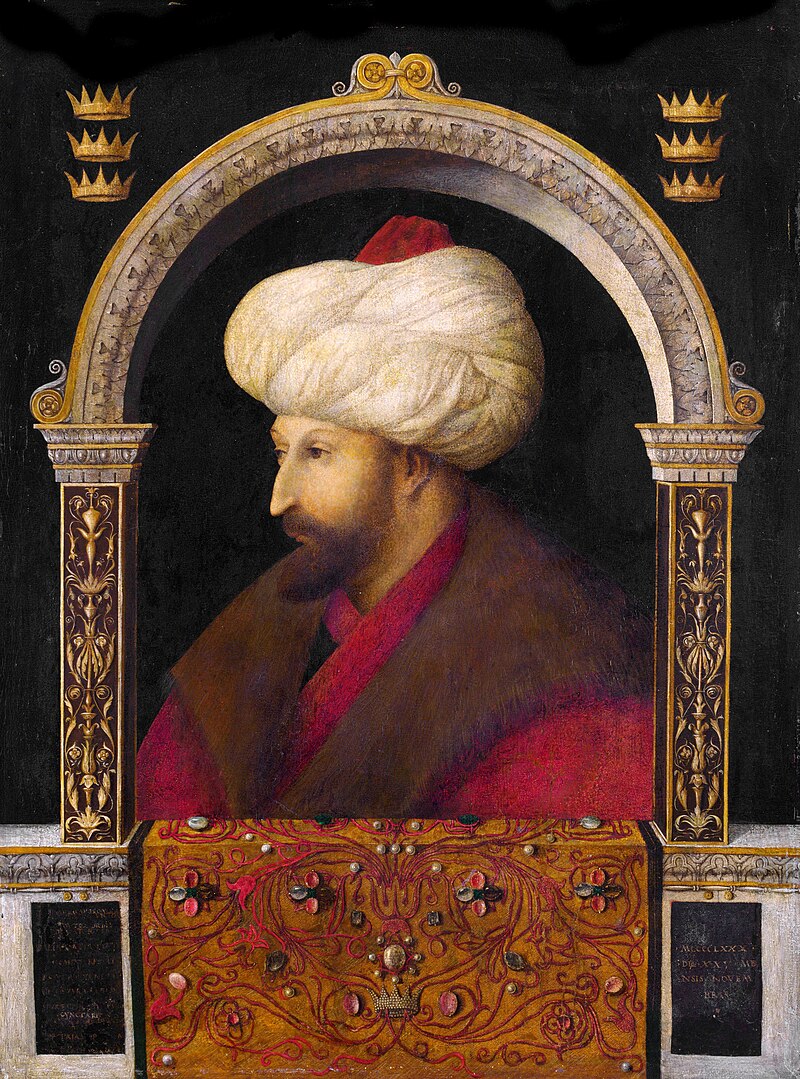
Apart from Mark Rylance’s, this is the face that draws me more than any other in the world and in time.
Gentile Bellini 003.jpg

It belongs to Sultan Mehmet II. It was probably painted by Venetian artist Gentile Bellini, brother of the more famous, more luminous Giovanni.

A framed print of this portrait has pride of place in one of three rooms I’ve recently reclaimed for the light in my London home. Long ago, fellow History Girl Laurie Graham, who is a genius with names, christened the two other bedchambers ‘The Princess Grace Memorial Suite’ and ‘The Joan Collins Annexe’. So this new room needed a name of its own too.


We have decided, for obvious reasons, to baptize it ‘The Sultan Mehmet II Mini-Suite’, especially given that its proportions are not exactly palatial. I would estimate that it could host only one substantial eunuch or two medium-sized concubines at any one time. And the latter would have to be on particularly good terms with one another.

The room is both Venetian and oriental in flavour, as also befits one focused on this portrait, which was created at the exact moment that Gothic architecture, with its Arabian arabesques and stone lace, was flourishing in la Serenissima.

Background detail only endears Sultan Mehmet II. He was born in 1432, ascending to the sultanate in 1451. He is famous for his restoration of Constantinople to its former glory after a century of siege, violence and dilapidation. He employed artisans from the entire known world to beautify his city. He loved Italian art and sought an Italian artist to paint his portrait.

His reign was a time of diplomacy between the Ottoman empire and Venice. Sultan Mehmet’s court for a time included Gentile Bellini, whose mission, starting in September 1479, was as visiting artist in residence and general cultural ambassador. Also part of the diplomatic effort was a mission was Bellini’s friend Giovanni Dario (whose house is now known as the most haunted in the city). I have also seen writings that suggest that the arches Bellini painted around the Sultan are based on those inside Giovanni Dario’s house. If this is true, it is a pleasant metaphor … the stones of Venice curve protectively and decoratively over the former enemy, sealing the peace with beauty.

The attribution to Gentile Bellini is not without controversy. Some have suggested that there are suspicious similarities between the sultan and a figure in Marco Palmezzano’s Jesus among the Doctors in the Temple.

This need not concern us here, any more than the fact that … I once saw Mark Rylance walking down my street near the Globe.

Mark Rylance is unavailable but we still have Sultan Mehmet II and that sultry profile.

Another reason to admire our Sultan is that he spoke Turkish and Arabic Greek, Persian, Latin, and Hebrew.

Plus, I present this picture of him smelling a rose.


The picture is taken from the Sarayı Albums Hazine 2153, folio 10a, courtesy of Wikimedia commons. How many men can be painted smelling a rose without looking faintly effeminate? All that emanates from this portrait is a delicate, appreciative sensuality. Only Mark Rylance could smell a rose as sexily as Sultan Mehmet could.

Sultan Mehmet II even looks good in coy three quarter view … as in this ‘alternative’ portrait from an unknown artist that was placed on Wikimedia Commons in 2011.


But I remain committed to Bellini portrait as the perfect representation of a fascinating man. If you want to see the original, you haven’t far to go. It’s at London’s National Gallery. The catalogue entry says, 'The painting is almost entirely repainted, especially in the figure. An old inscription, lower right, gives the date 25 November 1480. The lower left inscription is a more recent reconstruction; it includes the names Mehmet and Gentile Bellini … There is insufficient evidence for deciding whether the picture is a copy or a very damaged original.'

How did it get to London?

Succession time was dangerous in the Ottoman empire. Once can imagine the portrait smuggled out of the imperial chamber in the dead of night after the death of its protagonist. The painting may or may not have been sold in the Bazaar at Constantinople by the Sultan’s heirs. Thereafter it appears to have stayed in what is modern day Turkey for a few centuries.

Constantinople, or Istanbul was the posting of the eminent archaeologist Sir Austen Henry Layard, the man credited with making the bible true, by his excavations at Ninevah and Nimrud … the site of recent Islamic State atrocities against art.

It is said that Sultan Abdul Hamid II was unhappy when Layard was posted away from him in 1880 after a quarrel with Prime Minister Gladstone. Some sources claim that the sultan made a parting gift of this portrait to the exiting ambassador. Layard and his wife Lady Enid were shortly to settle in Venice, where they bought and restored a grand palazzo on the Grand Canal in the late 1870s. It became known as Ca’ Cappello Layard.

They moved their spectacular collection of Italian Renaissance art there and decorated the palace in sumptuous orientalist style. They were frightfully grand, as only English expats can be, with compulsory attendance at their soirees and parties by visiting luminaries.

Alternatively, there is the more picturesque version of the portrait’s provenance that one finds in John Julius’ Norwich’s excellent book, A Paradise of Cities. Norwich explains that Layard loved to tell the story of an anonymous man who accosted him in the street and tried to sell him the picture for the equivalent of £5. I love to think of it wrapped in brown paper with stained string. But the archaeologist refused, doubting its provenance. In the end, the man left the painting on the Layards’ doorstep like a foundling child. Layard was too grand to buy something that might have fallen off the back of a gondola, but he wasn't too fine to look a gift horse in the mouth. The painting was welcomed into Ca' Cappello.

Here is Sir Austen Henry Layard. Photograph by the London Stereoscopic Photographic Company, courtesy of Wellcome Images.


And here is his Vanity Fair caricature from Wikimedia commons. I'm posting it here because, unlike Mark Rylance or Sultan Mehmet, you won't find Layard at my house.


A nephew of Lady Enid recorded that the painting of Sultan Mehmet II was given a parrot for company at Ca’ Cappello Layard. One of the young boy’s duties was to go and cover the portrait with a green curtain at breakfast time, when the parrot performed ablutions that might otherwise have spattered the potentate.

Lady Enid’s copious diaries record many pet parrots. She even took them calling with her, and on holiday. She spoke of green parrots but their exact nature is not known. One was accused of giving her typhoid. Chains are also spoken of. This watercolour drawing of a ‘pet parrot on a perch’ (suitably oriental-looking) is from Wellcome Images.


There is a whole blog to be written about the parrots who lived with famous English expats and their friends on the Grand Canal at this point in time. But those birds are not kidnapping this one.

Henry Layard died in 1894, Lady Enid stayed on in Venice, continuing with a perfervid social life, entertaining Browning (whose parrot was called Jacko), Ruskin and royalty whenever possible.

The portrait of Sultan Mehmet II, like others in the Layard collection, was donated to the National Gallery after Lady Enid died in 1912.  But initially a 1909 Italian law on the export of art blocked the donation. Meanwhile Layard’s heir, Major Arthur Layard, pressed a claim for the Venetian portraits, based on an ambiguity of the wording of the will. Eventually he was compensated, and the Italian prime minister intervened to except the paintings from the export law. The dangers of World War I delayed the transport to London.

Sultan Mehmet II finally arrived on these shores in 1916 – and in my guest bedroom almost exactly a hundred years later.

 (Mark Rylance is also welcome at any time.)


Michelle Lovric’s website
the picture of Mark Rylance is from Wikimedia Commons
the original Sultan Mehmet picture comes from The Yorck Project: 10.000 Meisterwerke der Malerei, via Wikimedia Commons.