
Here's an almost entirely gratuitous picture of Mark Rylance, the thinking History Girl’s posset.
Just for your pleasure, and mine.
Please excuse the slightly intoxicated tone of this blog. I’ve only just finished watching Wolf Hall, and I am in love with every subtle crevice of Mark Rylance’s face.
When I informed Mary Hoffman of this parish about the new heart-fluttering inside my bodice, she told me tersely, ‘Stand in line’.
And when I mentioned it to Lucy Coats, history writer and fellow Guardian master class teacher, she snarled, ‘Stand in line. The whole internet is in love with Mark Rylance.’
I consulted a third researcher, who shall remain anonymous, only to hear that she nurtures a well accessorized fantasy in which she just won’t return all Mark’s calls and he is growing increasingly desperate. When I mentioned my own predilection for the doe-eyed boy, she growled, ‘Stand in line and take a number.’
I made a very small mouth.
I’m telling myself to sublimate, sublimate, sublimate. But all I can manage is snivel, and … substitute.
Apart from Mark Rylance’s, this is the face that draws me more than any other in the world and in time.
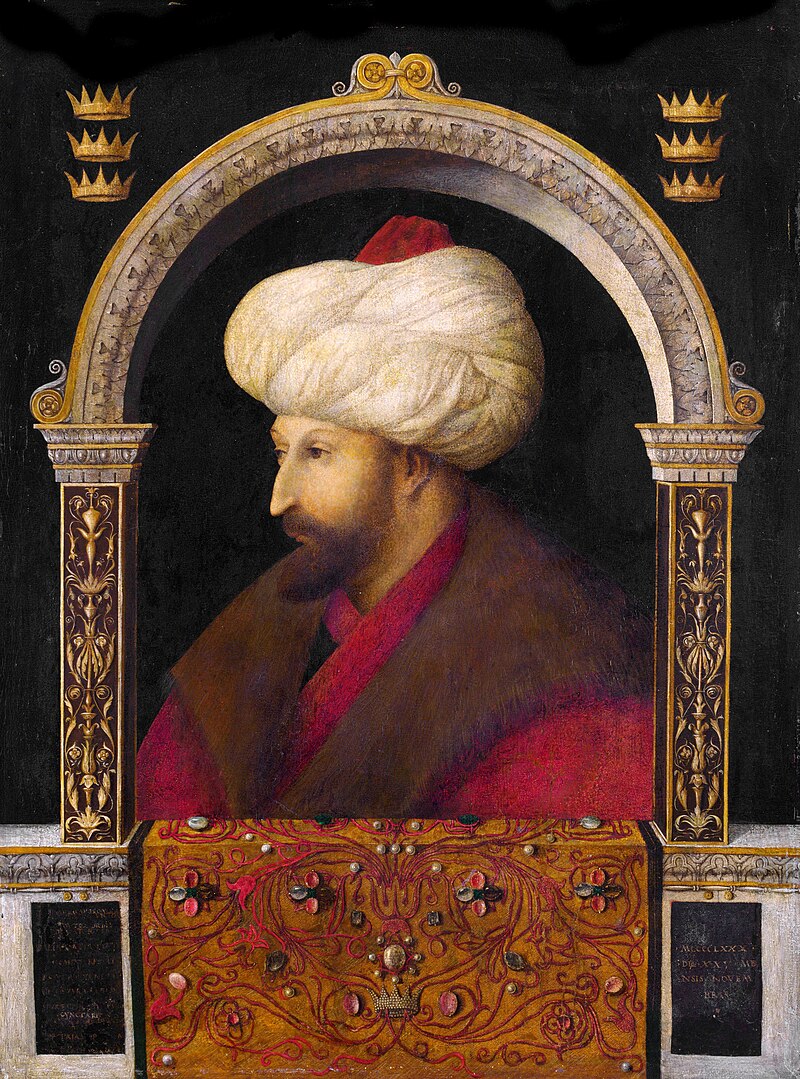
It belongs to Sultan Mehmet II. It was probably painted by Venetian artist Gentile Bellini, brother of the more famous, more luminous Giovanni.
A framed print of this portrait has pride of place in one of three rooms I’ve recently reclaimed for the light in my London home. Long ago, fellow History Girl Laurie Graham, who is a genius with names, christened the two other bedchambers ‘The Princess Grace Memorial Suite’ and ‘The Joan Collins Annexe’. So this new room needed a name of its own too.

We have decided, for obvious reasons, to baptize it ‘The Sultan Mehmet II Mini-Suite’, especially given that its proportions are not exactly palatial. I would estimate that it could host only one substantial eunuch or two medium-sized concubines at any one time. And the latter would have to be on particularly good terms with one another.
The room is both Venetian and oriental in flavour, as also befits one focused on this portrait, which was created at the exact moment that Gothic architecture, with its Arabian arabesques and stone lace, was flourishing in la Serenissima.
Background detail only endears Sultan Mehmet II. He was born in 1432, ascending to the sultanate in 1451. He is famous for his restoration of Constantinople to its former glory after a century of siege, violence and dilapidation. He employed artisans from the entire known world to beautify his city. He loved Italian art and sought an Italian artist to paint his portrait.
His reign was a time of diplomacy between the Ottoman empire and Venice. Sultan Mehmet’s court for a time included Gentile Bellini, whose mission, starting in September 1479, was as visiting artist in residence and general cultural ambassador. Also part of the diplomatic effort was a mission was Bellini’s friend Giovanni Dario (whose house is now known as the most haunted in the city). I have also seen writings that suggest that the arches Bellini painted around the Sultan are based on those inside Giovanni Dario’s house. If this is true, it is a pleasant metaphor … the stones of Venice curve protectively and decoratively over the former enemy, sealing the peace with beauty.
The attribution to Gentile Bellini is not without controversy. Some have suggested that there are suspicious similarities between the sultan and a figure in Marco Palmezzano’s Jesus among the Doctors in the Temple.
This need not concern us here, any more than the fact that … I once saw Mark Rylance walking down my street near the Globe.
Mark Rylance is unavailable but we still have Sultan Mehmet II and that sultry profile.
Another reason to admire our Sultan is that he spoke Turkish and Arabic Greek, Persian, Latin, and Hebrew.
Plus, I present this picture of him smelling a rose.

The picture is taken from the Sarayı Albums Hazine 2153, folio 10a, courtesy of Wikimedia commons. How many men can be painted smelling a rose without looking faintly effeminate? All that emanates from this portrait is a delicate, appreciative sensuality. Only Mark Rylance could smell a rose as sexily as Sultan Mehmet could.
Sultan Mehmet II even looks good in coy three quarter view … as in this ‘alternative’ portrait from an unknown artist that was placed on Wikimedia Commons in 2011.

But I remain committed to Bellini portrait as the perfect representation of a fascinating man. If you want to see the original, you haven’t far to go. It’s at London’s National Gallery. The catalogue entry says, 'The painting is almost entirely repainted, especially in the figure. An old inscription, lower right, gives the date 25 November 1480. The lower left inscription is a more recent reconstruction; it includes the names Mehmet and Gentile Bellini … There is insufficient evidence for deciding whether the picture is a copy or a very damaged original.'
How did it get to London?
Succession time was dangerous in the Ottoman empire. Once can imagine the portrait smuggled out of the imperial chamber in the dead of night after the death of its protagonist. The painting may or may not have been sold in the Bazaar at Constantinople by the Sultan’s heirs. Thereafter it appears to have stayed in what is modern day Turkey for a few centuries.
Constantinople, or Istanbul was the posting of the eminent archaeologist Sir Austen Henry Layard, the man credited with making the bible true, by his excavations at Ninevah and Nimrud … the site of recent Islamic State atrocities against art.
It is said that Sultan Abdul Hamid II was unhappy when Layard was posted away from him in 1880 after a quarrel with Prime Minister Gladstone. Some sources claim that the sultan made a parting gift of this portrait to the exiting ambassador. Layard and his wife Lady Enid were shortly to settle in Venice, where they bought and restored a grand palazzo on the Grand Canal in the late 1870s. It became known as Ca’ Cappello Layard.
They moved their spectacular collection of Italian Renaissance art there and decorated the palace in sumptuous orientalist style. They were frightfully grand, as only English expats can be, with compulsory attendance at their soirees and parties by visiting luminaries.
Alternatively, there is the more picturesque version of the portrait’s provenance that one finds in John Julius’ Norwich’s excellent book, A Paradise of Cities. Norwich explains that Layard loved to tell the story of an anonymous man who accosted him in the street and tried to sell him the picture for the equivalent of £5. I love to think of it wrapped in brown paper with stained string. But the archaeologist refused, doubting its provenance. In the end, the man left the painting on the Layards’ doorstep like a foundling child. Layard was too grand to buy something that might have fallen off the back of a gondola, but he wasn't too fine to look a gift horse in the mouth. The painting was welcomed into Ca' Cappello.
Here is Sir Austen Henry Layard. Photograph by the London Stereoscopic Photographic Company, courtesy of Wellcome Images.

And here is his Vanity Fair caricature from Wikimedia commons. I'm posting it here because, unlike Mark Rylance or Sultan Mehmet, you won't find Layard at my house.

A nephew of Lady Enid recorded that the painting of Sultan Mehmet II was given a parrot for company at Ca’ Cappello Layard. One of the young boy’s duties was to go and cover the portrait with a green curtain at breakfast time, when the parrot performed ablutions that might otherwise have spattered the potentate.
Lady Enid’s copious diaries record many pet parrots. She even took them calling with her, and on holiday. She spoke of green parrots but their exact nature is not known. One was accused of giving her typhoid. Chains are also spoken of. This watercolour drawing of a ‘pet parrot on a perch’ (suitably oriental-looking) is from Wellcome Images.

There is a whole blog to be written about the parrots who lived with famous English expats and their friends on the Grand Canal at this point in time. But those birds are not kidnapping this one.
Henry Layard died in 1894, Lady Enid stayed on in Venice, continuing with a perfervid social life, entertaining Browning (whose parrot was called Jacko), Ruskin and royalty whenever possible.
The portrait of Sultan Mehmet II, like others in the Layard collection, was donated to the National Gallery after Lady Enid died in 1912. But initially a 1909 Italian law on the export of art blocked the donation. Meanwhile Layard’s heir, Major Arthur Layard, pressed a claim for the Venetian portraits, based on an ambiguity of the wording of the will. Eventually he was compensated, and the Italian prime minister intervened to except the paintings from the export law. The dangers of World War I delayed the transport to London.
Sultan Mehmet II finally arrived on these shores in 1916 – and in my guest bedroom almost exactly a hundred years later.
(Mark Rylance is also welcome at any time.)
Michelle Lovric’s website
the picture of Mark Rylance is from Wikimedia Commons
the original Sultan Mehmet picture comes from The Yorck Project: 10.000 Meisterwerke der Malerei, via Wikimedia Commons.


